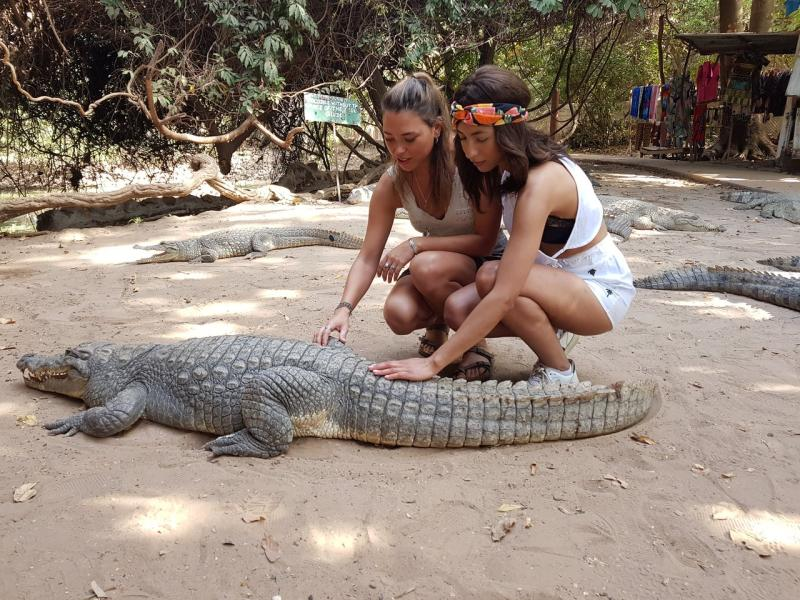
In The Gambia, you can walk up to a full-grown West African crocodile and touch it.
Heavy. Ancient. Two metres of muscle and scale, lying on the bank in the sun.
You can crouch beside it, stroke its back, lift its tail, and pose for a photograph.
It will not move.
This happens every day at a place called Kachikally, in the town of Bakau on The Gambia's western coast. Tourists do it. Locals do it. Children do it.
There is reason for this.
But before any explanation, there is a country.
And the country begins with a river.
The River and the Crocodile
The Gambia is not a country you can easily explain on a map.
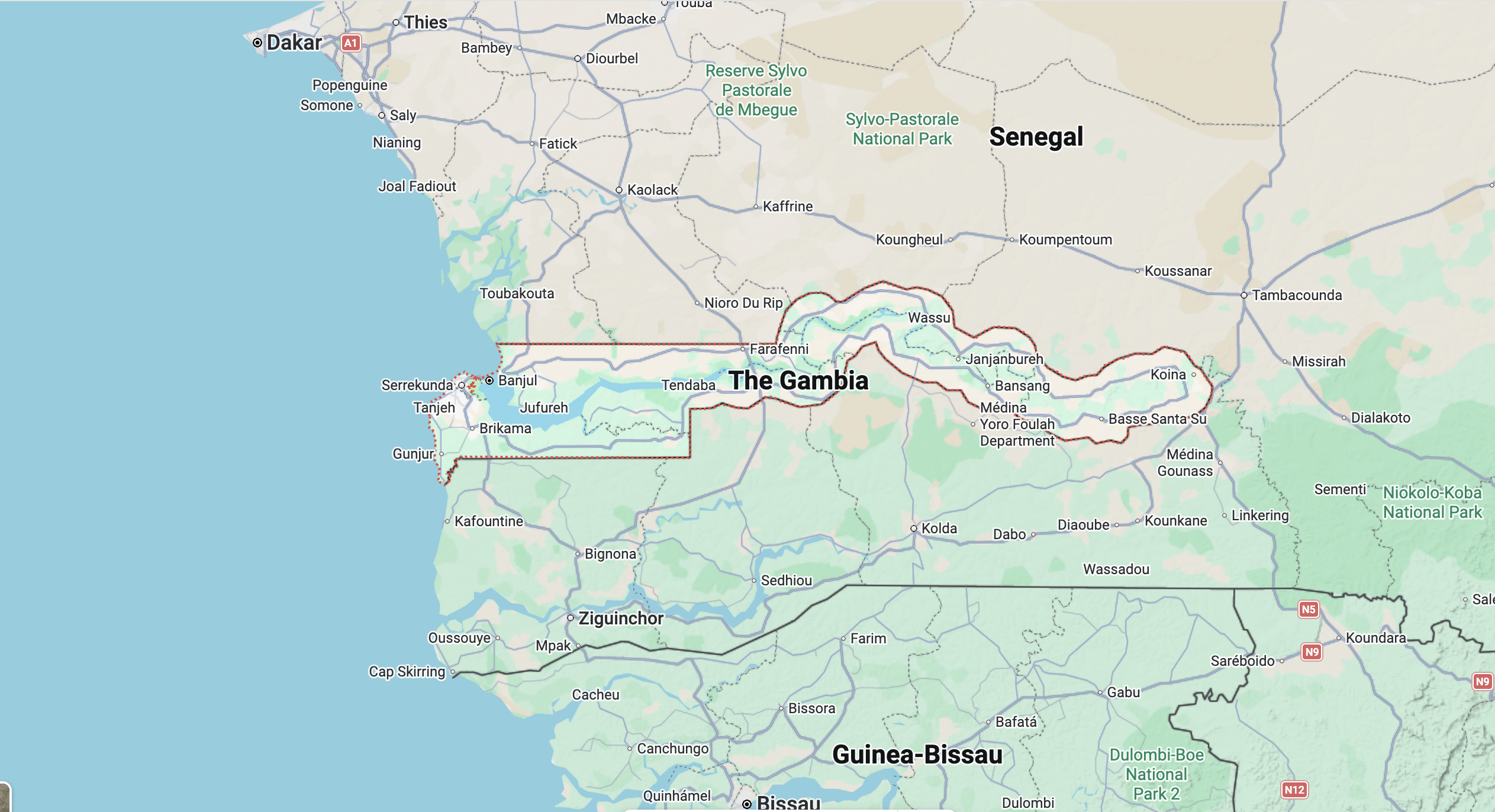
It is a narrow strip of land, never more than fifty kilometres wide, stretching nearly five hundred kilometres inland from the Atlantic coast of West Africa. On every side but the ocean, it is surrounded by Senegal.
The Gambia River cuts through the centre of the country from east to west, and the country simply follows it. The British, who colonised the region in the nineteenth century, claimed as much land as their gunboats could reach from the water. What they could reach became The Gambia. Everything else remained French Senegal.
People travel by pirogue: flat-bottomed wooden boats that navigate the water and its tributaries. Ferry crossings connect the north and south banks. Fishermen work the water at dawn. Children grow up beside it.
If you cannot swim in The Gambia, you better hope the gods are on your side.
And in this river, the crocodile has always been present.
So present, in fact, that it has worked its way into every corner of Gambian life. Pull out a 1 Dalasi coin, and you will find one curled around the number, a design in circulation since 1971. Hold any Gambian banknote up to the light, and the watermark that emerges is a crocodile's head, a security feature embedded by the Central Bank itself.
To understand how this came to be, you have to travel to three pools.
The Three Sacred Pools
They are Kachikally, Folonko, and Berending.
The three sacred crocodile pools are scattered across The Gambia. One in the west near the capital, Banjul. One at the southernmost tip of the country, a few steps from the Senegalese border. One on the remote North Bank, where the roads thin out and the bush closes in.
Together, they have been operating for over five centuries.
Each is guarded by a hereditary custodian family; in each, the crocodiles are sacred to the surrounding community: untouchable, unharmed, uneaten.
And each one began with a story.
Kachikally: The Pool That Was a Test
Kachikally sits in the heart of Bakau, roughly twelve kilometres west of Banjul. It occupies nine acres of tropical forest that has remained untouched for over four hundred years. Silk cotton trees, baobabs, and fig trees form a canopy over the water. Kingfishers nest in the branches. Vervet monkeys move through the leaves.
In the pool below, eighty to a hundred crocodiles rest on the banks and drift just beneath the surface.
How did the crocodiles come to be?
The Bojang family.
Centuries ago, a man named Ncooping Bojang founded the settlement of Bakau. He had two sons: Tambasi and Jaali Kumba.
One day, a woman appeared before the brothers in distress.
She was not an ordinary woman.
She was a jinn, a spirit of the bush. Her child, she said, had fallen into a well. Without hesitation, the brothers dove in.
Inside, they found the child sitting calmly on a rock, surrounded by water. Unharmed.
The spirit revealed the truth. It had been a test. She had wanted to know what kind of men the Bojang brothers were.
She had her answer.
As a reward, she declared the pool sacred. She blessed the water with the power to grant fertility. And she gave the Bojang family what they had held for five centuries: custodianship of the pool, passed from father to son, unbroken.
The name came from another version of the same story. As the spirit leaned forward to draw water, her child slipped in. She cried out a single word.
'Kachikaly.'
In Mandinka, ‘achika/kachika’ means: pick it up and put it down.
The pool has carried that name ever since.
To populate the water, the brothers were given one final instruction. Whatever they caught first in their fishing nets, they must release into the pool.
They caught two crocodiles.
Those two animals are believed to be the ancestors of every crocodile living in Kachikally today.
Credit: https://thetraveleco.com/
Folonko: The Daughter of Kachikally
Travel south from Bakau, all the way to Kartong at The Gambia's southernmost edge, and you will find Folonko.
It is older than Kachikally.
Nearly six hundred years old, making it the eldest of the three pools. It sits in a deep grove near the coastal dunes: a murky green swamp, lily-choked, roughly ten metres deep. Around ten crocodiles live here. Left unfed, they roam freely. Sightings are unpredictable.
Folonko offers nothing but the sacred itself: simple bathing stalls and the instruction to remove your shoes before entering the compound.
The name comes from the phrase 'fon loo', meaning to bow your head to the ground. Some say this references Islamic prostration.
That connection to Islam is deliberate.
Folonko is attributed to Sheikh Umar Futiu Taal, born in 1793, one of the most significant Islamic scholars West Africa has ever produced. A leader of the Tijaniyya Sufi order, a warrior of the faith. He sanctified Folonko during his travels through the Senegambia region.
But the pool was already ancient by the time he arrived.
The deeper oral traditions connect it to the pre-Islamic Soninke people. Sheikh Umar Taal did not create the sacred site. He recognised one that already existed and gave it a new spiritual layer.
The presiding spirit of Folonko, according to tradition, is the daughter of the spirit of Kachikally.
Berending: The Pool the World Has Not Found
On the North Bank of the Gambia River, accessible by ferry from Banjul and a short ride through the bush, sits the third pool.
Berending.
It is the least documented.
Crocodile sightings are rare. Berending draws from saltwater streams rather than freshwater springs and sits surrounded by tropical vegetation and silk cotton trees, looking, from the outside, like any other pond.
The National Centre for Arts and Culture of the Gambia describes it simply: Berending serves the same purpose as Kachikally and Folonko and is nevertheless a sacred place.
That is all that needs to be said.
The Healing Power of the Water
The sacred pools function, above everything else, as fertility shrines.
Women who have struggled to conceive travel from across the country, and sometimes from much further, to undergo ritual bathing in the sacred water.
The spiritual framework behind this begins with a belief called 'kuntofengo'.
In the Gambian understanding, infertility is not simply a medical condition. It is a spiritual one.
A woman who cannot conceive is believed to be afflicted by a spirit husband, called 'jinnoo' in Mandinka, 'rab' in Wolof. This spirit grows jealous of her human husband and disrupts pregnancies through nightmares and interference in the invisible world.
Western medicine cannot reach this.
Only the sacred water can.
The pools offer far more than fertility.
Long-term illness. Financial ruin. Familial conflict. Political ambition. Before The Gambia's 2016 presidential election, politicians made the journey to Kachikally to pray.
All Gambian wrestlers, it is said, must visit Folonko before they can achieve victory in competition.
And then there is Charlie.
Charlie is an albino crocodile at Kachikally. White, rare, unmistakable against the dark water.
Local belief holds that seeing Charlie is a guarantee: your prayer will be answered.
In Gambian cosmology, the full moon carries the image of a crocodile. The creature and the cycle of life are understood as one and the same.
The Steps Into the Water
Coming to the pool is a structured encounter with the sacred, and every step has its place.
A supplicant arrives bearing kola nuts. This is the universal offering, the one thing you cannot arrive without. Some also bring milk, cloth, or money, but the kola nuts are non-negotiable.
The nuts are shared among the custodian family, who gather to pray.
An elder draws water from the pool and blesses it.
At Kachikally, the supplicant is taken to a private shelter beside the pool. There, specially trained women of the Bojang clan perform the bathing. At Folonko, women use the simple stalls and wash with the pond water directly.
After the bath, the woman receives a bottle of sacred water to take home. It is used twice a day: early in the morning and before going to bed.
Then comes the drumming and the dancing.
But before leaving, the supplicant receives instructions that carry the full weight of spiritual law.
She must remain faithful to her husband for one full year. She must not sleep with any other man. Some accounts add that she must not shake hands with any man during this period.
And there is one obligation beyond all others.
If the wish is fulfilled: if the child comes, if the healing arrives, if the victory is won, the supplicant must return to the pool. A second stage of rituals must be completed.
Failure to return is a serious breach of spiritual protocol.
The evidence of those who do return is written into Gambian society itself. Children conceived through successful prayers are traditionally given 'Kachikally' as part of their name.
Thousands of Gambians carry that name.
Why the Crocodiles Don't Bite
Which brings us back to the question at the beginning.
Why don't they bite?
The custodian families have a clear answer.
The crocodiles are under the authority of the presiding spirit. The Bojang family claims the ability to communicate with the animals directly, particularly during the periodic cleaning and digging of the pool, when they must instruct the crocodiles to keep away from the water. The spirit Kachikally controls them. She prevents them from wandering. She prevents them from harming visitors.
That is the spiritual explanation.
Science arrived at a different answer.
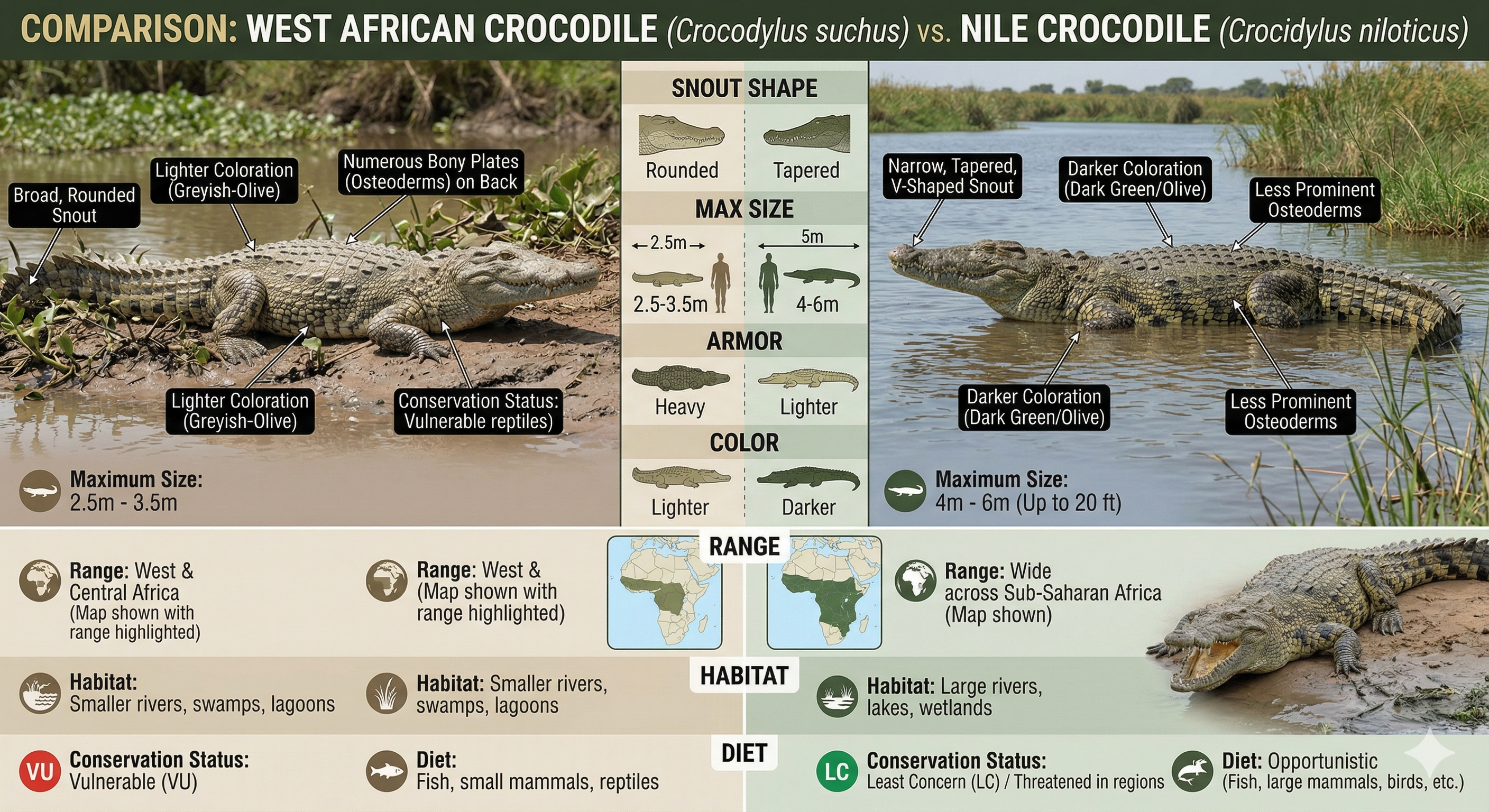
For most of the twentieth century, the crocodiles in Gambian pools were assumed to be Nile crocodiles, 'Crocodylus niloticus': one of the most dangerous animals on the planet, responsible for an estimated three hundred or more human deaths across Africa every year.
But in 2011, a landmark genetic study changed that classification entirely.
The crocodiles in the sacred pools are not Nile crocodiles.
They are West African crocodiles: 'Crocodylus suchus'. A distinct species. Smaller, typically two to three metres compared to the Nile crocodile's five or more. And notably, fundamentally less aggressive.
This distinction had been understood long before modern science confirmed it.
Ancient Egyptian priests knew the difference thousands of years ago. They specifically selected 'Crocodylus suchus' for their temple rituals at Crocodilopolis, where the animals were kept as pampered pets and worshipped as manifestations of the god Sobek. The Egyptians recognised something in this particular animal that made it suited for sacred life alongside humans.
There are also simpler factors at work.
At Kachikally, the crocodiles are fed regularly, keeping them full.
A well-fed predator does not hunt.
Over generations, they have also grown used to humans.
Raised in this enclosed space, they behave differently from crocodiles in the wild.
The Taboos That Kept Them Alive
The crocodiles have survived for over five centuries through something older and more stubborn than any conservation framework.
Taboo.
The first and most absolute: harming a sacred crocodile is forbidden. In the Gambian understanding, the crocodiles are something more than animals: intermediaries between the physical world and the spiritual one, connected to ancestors, capable of carrying human petitions to the realm beyond. To harm one is not a wildlife offence. It is a spiritual transgression against the guardians of the community itself.
This belief has held through everything: colonialism, political upheaval, urbanisation, and poverty.
The second taboo extends to the land around the pools.
No tree may be cut from the forests surrounding the sacred sites.
The prohibition is purely spiritual: the forests belong to the spirit, and disturbing them violates the same covenant that governs the pools.
The result is extraordinary.
Six acres of forest sit in the middle of urban Bakau.
The city has grown around it for four hundred years.
Not a single tree has been cut.
No law enforced this.
The belief did.
The pools are also held together by families.
At Kachikally, the Mandinka Bojang family has held custodial responsibility for over five hundred years. The role passes from father to son. The Bojang family also serves as Alkalo, the village leader of Bakau, uniting political and spiritual authority in the same hands.
At Folonko, the Jaiteh family holds custodianship, having succeeded an earlier lineage. At Berending, the Sunka family serve as custodians, though they have remained largely out of public record.
The custodians carry responsibilities that go far beyond feeding the crocodiles. They lead prayers. They bless the water. They train the women who conduct the fertility rituals. They preserve spiritual knowledge held only in memory.
Every ten years, the community gathers at Folonko for a ceremony of re-digging. Drum calls go out. Cultural activities and prayers fill the days. The pool is excavated and maintained by collective hands.
Covenant renewal, performed on schedule, generation after generation.
The agreement made at the water’s edge has been honoured for centuries.
And the crocodiles are still there.
Still resting in the sun.
Still letting people walk up to them.
Still not moving.
New Language Resources
Learning common phrases is one of the quickest ways to connect with speakers and hear the language in everyday life. Here are phrase guides you can use right away:
- ✅ Common Bambara Phrases
- ✅ Common Kpelle Phrases
- ✅ Common Zarma Phrases
- ✅ Common Hausa Phrases
- ✅ Common Mooré Phrases
- ✅ Common Igbo Phrases
- ✅ Common Fon Phrases
- ✅ Common Fulani Phrases
- ✅ Common Yoruba Phrases
- ✅ Common Kikongo Phrases
- ✅ Common Lingala Phrases
- ✅ Common Tshiluba Phrases
Thank you to the language guardians who make these articles possible.
Join the Lughayangu Community!