Have you ever woken up in the middle of the night, fully alert... but frozen?
Your eyes dart around the room. You try to move your fingers. Nothing. You want to scream, but not even a whisper escapes your lips.
Someone walks into your room, speaks to you, and even shakes you. You’re fully aware, but you can’t respond. They walk away, confused.
Then it happens.
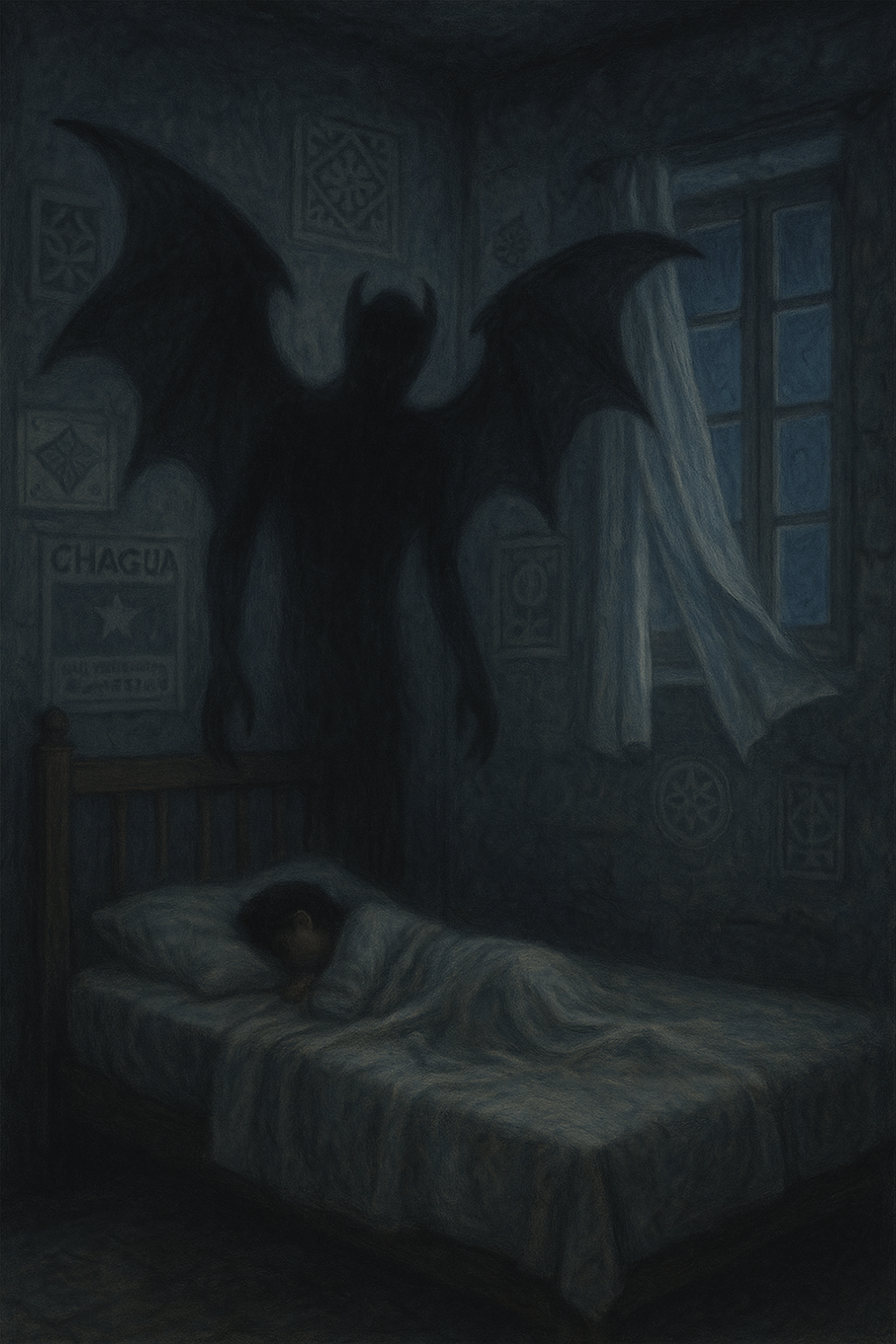
A shadow forms in the corner of the room. It creeps closer. It presses down on your chest. You’re trapped under something invisible, something realer than a dream.
And just like that, you snap out of it.
If you’ve ever been through this, I’m sorry for the reminder.
If not… count yourself lucky.
This terrifying episode has a name: sleep paralysis.
Science? Boring. Let’s talk tradition.
Sure, doctors will tell you it’s a glitch in your REM cycle. Something-something about your body being asleep while your brain is awake.
But who cares?
Let’s look at how African tradition explains it.
And for that, we head to the Swahili coast, to the spice-scented island of Zanzibar.
More specifically, Pemba.
When the Island Didn’t Sleep
In 1995, something strange happened in Pemba.
A string of people started showing up at police stations and mosques, trembling, wide-eyed, talking about it.
They all said the same thing: a ghost-like creature entered their rooms at night, pinned them down, and vanished.
Some said it crushed them. Others said it tried to suffocate them. A few said it even spoke to them, ordering them to tell others about the encounter or face another visit.
It wasn’t just the attacks that scared people. It was the shadow.
No matter what form the creature took, the shadow always remained the same: shaped like a bat’s wing.
So they named it after the one thing they could describe.
In Swahili, “popo” means bat, and “bawa” means wing.
Enter: Popobawa.
Are ghosts born? Or have they always existed?
The first recorded sighting of the Popobawa was in 1965, just after the Zanzibar Revolution that overthrew Sultan Abdullah and installed Sheikh Abeid Karume as the first president of Zanzibar.
Since then, it’s said to reappear every five years:
1970, then 1975, 1980, then 1985, 1990, then 1995, when the biggest wave of sightings swept across Pemba, Unguja, and even the coastal mainland, then in 2000, and finally, in 2007.
Notice anything?
All those years, except 2007, were election years in Tanzania.
Coincidence?
Some say the Popobawa is the angry spirit of Karume himself, assassinated in 1972. That he returns to haunt the islands every election season. To punish betrayal. To push people to vote for CCM, the party he helped found.
Say what you will, but the party’s still in power.

How do you fight a ghost like this?
Zanzibaris have tried everything:
Amulets and charms, worn for protection.
Religious rituals, especially Islamic prayers and Quran verses.
Silence. Don’t speak its name. Don’t even talk about it.
Group sleep. Safety in numbers.
Night vigils. Bonfires. Storytelling. Anything to avoid falling asleep alone.
Still, every few years, the fear returns.
Election is Coming Up
The next election is in two months. October 29, 2025.
If the pattern holds, the Popobawa might return.
So… planning a trip?
Maybe skip Pemba this time.
Or don’t.
After all, it’s just a legend.
Right?
But here's something to chew on:
What if the scariest thing about the Popobawa isn't the ghost…
But the silence it demands?
A spirit that punishes you for speaking out.
A shadow that only appears when it's time to choose your future.
What does that say about the fears we carry into the voting booth, the ones passed down, whispered, and weaponised?
Maybe Popobawa isn’t just folklore.
Maybe he’s a mirror
Special Mentions
If this haunted tale left you looking over your shoulder, here are a few more spirits worth knowing:
Language of the Week: Olunyala
Olunyala, also known as Abanyala, Nyala, Banyala, or Abanyala ba Ndombi, is a Bantu language spoken in western Kenya.
It’s part of the broader Luhya language cluster, which includes Bukusu, Kimaragoli, Abakhayo, Abanyole, Abamarachi, Olutsotso, Abawanga, Abamarama, Abasamia, Kisa, and more.
A special shout-out to Balovera Edwin Ongacho, a leading contributor and linguistics researcher whose work has been instrumental in documenting and preserving the language on the Lughayangu platform.
Curious to learn more? You can explore his work on his blog and dive deeper into Olunyala!
******************
That’s it for this week.
Until next time, maybe sleep with one eye open.
Mike.
Join the Lughayangu Community!