Eritrean National Festival (Festival Eritrea / Expo)
National event representing all nine recognised Eritrean nation groups: Tigrinya, Tigre, Saho, Afar, Kunama, Bilen, Hedareb, Nara and Rashaida.
When it happensThe month is settled. Organisers set the exact days each year.
Where it happens
📍 Asmara · Eritrea
Annual festival celebrating Eritrean culture, arts, and traditions
About Eritrean National Festival (Festival Eritrea / Expo)
Festival Eritrea, usually called the National Eritrean Festival or simply Expo, is Eritrea's main national cultural exposition.
It is held at the Asmara Expo grounds in the capital, Asmara, in the Central Region (Zoba Maekel).
The festival grows out of the Bologna Festival, which Eritrean exiles and the Eritrean People's Liberation Front began in Bologna, Italy, in 1974 to unite the diaspora and raise money for the independence war.
After Eritrea won independence in 1991, the event was brought home to Asmara, first held there in 1992 and organised by the former Bologna committee.
The Expo compound is laid out as a set of regional villages, one for each of the six administrative regions, where the traditions and living standards of the nine nation groups are shown.
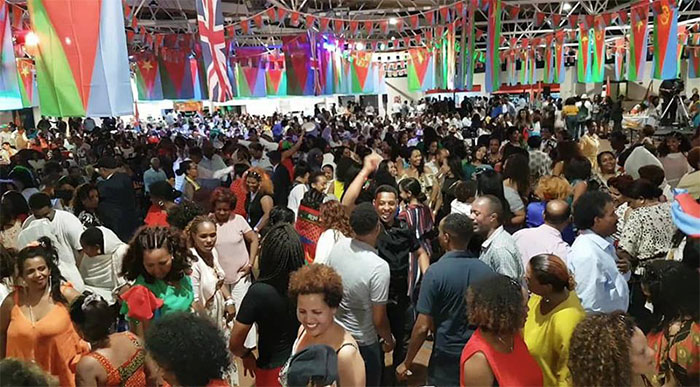
Visitors walk between reconstructed houses such as the highland Tigrinya hidmo, round agdo huts, and Rashaida tents, watch live music and dance, eat regional food, and see exhibitions of crafts, books, paintings and sculpture, agriculture, Red Sea biodiversity, and industry. There are seminars, children's programs, film screenings and trade bazaars. The government frames the event around the theme of unity in diversity.
The festival tradition also lives on in the diaspora, where annual Eritrean festivals are held in Europe and North America. Since 2023, several of these diaspora events have seen violent clashes between government supporters and opponents.
Origins & significance
The festival began as the Bologna Festival in Bologna, Italy, in 1974, started by Eritrean exiles and the Eritrean People's Liberation Front (EPLF) to bring the diaspora together and raise funds for the war of independence against Ethiopia.
Bologna was called Eritrea's second city during the struggle, and the festival ran annually until 1991.
After independence in 1991, the festival moved to Asmara, first held there in 1992 under the former Bologna committee; one state source instead dates the domestic Expo festival to 1994.
Since then it has been an annual state institution presenting the country's cultural diversity and development. In 2024, the festival marked the 50th anniversary of the 1974 Bologna Festival.
How it's celebrated
Cultural performances, art exhibitions, traditional music
Plan your visit
The festival is held at the Asmara Expo compound, usually for seven to nine days between late July and August. Asmara sits at 2,325 m, so days are mild, and the kremti summer rains fall in this season.
Eritrea is a hard place to visit. Foreign visitors need a visa, and a travel permit is required to go beyond about 25 km outside Asmara, with numerous military checkpoints.
The Expo compound is generally open to the public during daytime and evening hours.
The culture
Highland Tigrinya women wear the zuria, a white cotton dress with hand-embroidered tibeb borders, and a netsela shawl.
Afar men carry the jile dagger.
Rashaida women wear embroidered dresses and a silver-beaded face veil called the burqa, and men wear the thobe.
Each of the nine nation groups presents its own dress in the regional villages.
Music is performed by cultural troupes representing all nine nation groups. Common instruments include the krar, a five or six-string bowl lyre; the chira-wata, a single-string bowed lute rooted in Tigrinya music; the kebero, a double-headed drum used across groups; and the abangala, a single-string gourd instrument associated mainly with the Kunama. Both traditional and modern amplified music, including the electric and bass krar, feature at the festival.
Signature dances include the Tigrinya quda circle dance; the shelil hair-swinging dance of Bilen and Tigre women; Afar dagger dances with the jile; Rashaida sword dances; and Kunama and Nara harvest circle dances.
Help keep this accurate
Festivals change year to year. If you know this one, from the community or as an organiser, a quick confirmation or correction keeps it right for everyone.
Log in to confirm this festival or suggest a change.
Embed this page on your site
Add a badge that links back to this official festival page.