Morija Arts & Cultural Festival
Lesotho's premier arts and heritage festival
When it happensThe month is settled. Organisers set the exact days each year. It runs on and off, often depending on funding, so check before booking.
Where it happens
📍 Maseru · Morija · Lesotho
Major cultural event celebrating Basotho arts, music, and traditions
About Morija Arts & Cultural Festival
The Morija Arts & Cultural Festival, also called the Morija Festival, is an annual celebration in Morija, a historic town in the Maseru District of Lesotho about 35 km south of the capital, Maseru.
It is coordinated by the Morija Museum & Archives, the oldest museum and archive in Lesotho, established in 1956. The festival is widely described as Lesotho's premier cultural event. It was first held in 1999.
The idea grew out of a hard moment in Lesotho's history. After the disputed 1998 elections, violence broke out in Maseru, and a SADC military intervention followed. Community members asked the Morija Museum & Archives to help bring healing, and the festival was the result.
Its slogan is 'Kaofela re chabana sa khomo,' which the organisers render in English as 'Unity in Diversity,' though the phrase literally speaks of Basotho becoming one nation through marriage and cattle bridewealth.
The festival brings together Basotho of all backgrounds to share music, dance, poetry, drama, crafts and food, and it also hosts performers from neighbouring cultures. Over the years it built a second arm, a national schools cultural competition in traditional dance, instruments, drama and poetry, with qualifiers across Lesotho feeding into the main event.
The festival ran annually from 1999 through the early-to-mid 2010s, then lapsed for several years due to funding problems, with the COVID-19 pandemic preventing events around 2020. It was revived in 2024 and organisers said they intend it to be annual again.
Morija itself is central to the story. It was founded in 1833 as the first mission station of the Paris Evangelical Missionary Society, at the invitation of King Moshoeshoe I, and became known as 'Selibeng sa Thuto,' the Well-Spring of Learning.
Origins & significance
Founded in 1999 by the Morija Museum & Archives as a cultural-recovery and reconciliation effort after the 1998 post-election violence in Maseru and the SADC (Operation Boleas) intervention, and as a way to revive tourism.
It aimed to promote peace, unity and national confidence among the Basotho while showcasing Lesotho's heritage. It is staged in Morija, founded in 1833 as the first Paris Evangelical Missionary Society mission at the invitation of King Moshoeshoe I, and long known as 'Selibeng sa Thuto' (Well-Spring of Learning).
How it's celebrated
Art exhibitions, music performances, traditional dance, poetry readings
Plan your visit
The festival is held in Morija, about 35 km south of Maseru on the road toward Mafeteng, reachable by minibus taxi from Maseru.
It takes place in late September or early October in Lesotho's spring, at high altitude, so pack for variable weather.
The Lesotho loti is pegged one-to-one with the South African rand, and rand is accepted. Confirm current dates and any ticketing through the Morija Museum & Archives before travelling.
Whose festival it is
The culture
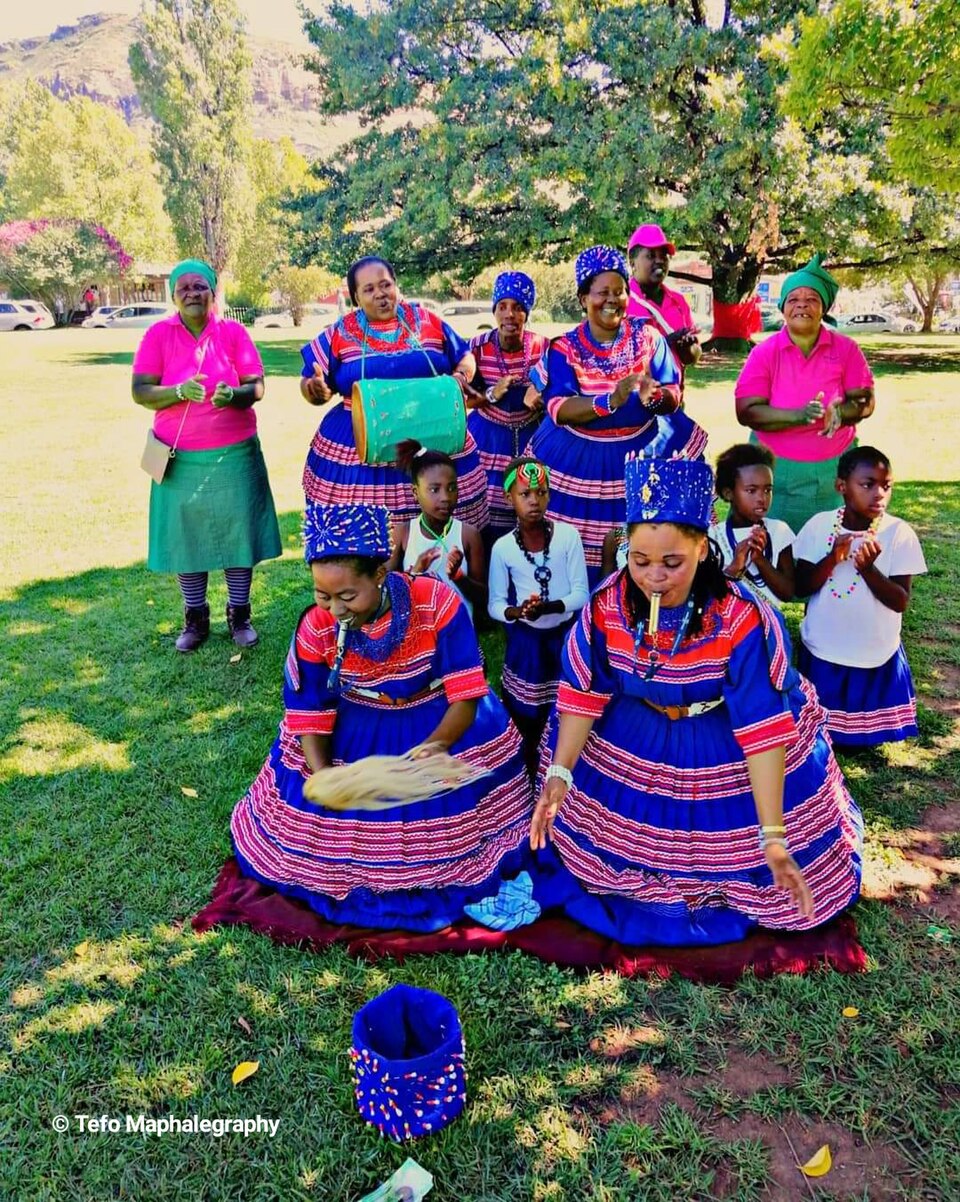
Basotho dress is central. Men and women wear the Basotho blanket (kobo), a heavy patterned woollen blanket that is a national garment; prestige brands include Seanamarena and Victoria England, with designs carrying symbols such as the corncob (poone). The mokorotlo, a conical grass hat made from mosea or leholi grass and said to be inspired by Mount Qiloane, is the national symbol and appears on Lesotho's flag. Dancers often add shields, and men carry the molamu (fighting stick).
Live music is a major draw, spanning traditional Basotho choral singing, praise poetry and famo, an accordion- and concertina-driven genre rooted in migrant mineworker culture (the accordion is the 'koriana, ' the concertina the 'korosetina, ' the drum the 'moropa'). Indigenous instruments include the lesiba, a mouth-resonated stringed wind instrument played with a quill and regarded as Lesotho's national instrument; the thomo, a woman's musical bow; the setolotolo, a mouth bow; and the lekope. The festival also features jazz, gospel and contemporary fusion acts.
Signature Basotho dances include mokhibo, a women's kneeling dance driven by shoulder movements, and mohobelo, a men's striding and stamping dance with high kicks, performed with a molamu (stick) and with named variants such as se-matsieng. Men also perform mokorotlo. The gumboot dance, of South African mine origin, features regionally. Guest troupes from neighbouring cultures perform dances such as the Zulu and Ndebele ndlamu.
Help keep this accurate
Festivals change year to year. If you know this one, from the community or as an organiser, a quick confirmation or correction keeps it right for everyone.
Log in to confirm this festival or suggest a change.
Embed this page on your site
Add a badge that links back to this official festival page.