Mwaka Kogwa Festival
Mwaka Kogwa is the traditional Swahili New Year festival of Zanzibar.
When it happensTimed by the season, the harvest or the moon, so it drifts by weeks from year to year.
 Source: Wikimedia
 Where it happens
📍 Makunduchi (Kae) · Unguja South District · Zanzibar · other parts of Unguja Island · Pemba Island (including Kojani islet) · Mafia Island · Tanzania
Traditional Shirazi New Year festival featuring unique ritual fighting with banana stalks to settle past year's disputes and welcome good fortune for the coming year
About Mwaka Kogwa Festival
Mwaka Kogwa marks the New Year of the traditional Swahili solar calendar. The name comes from mwaka (year) and koga (to bathe or wash), giving a sense of washing away the old year. It is also called Nairuz and Siku ya Mwaka. The biggest celebration is in Makunduchi, a town on the south of Unguja Island that is a centre of the Wahadimu nation group. Smaller observances take place elsewhere on Unguja, on Pemba (notably Kojani islet) and on Mafia Island.
Local tradition links the festival to Shirazi settlers said to have come from Persia, and popular accounts call it the Shirazi or Persian New Year. Scholars treat this with caution. The anthropologist Odile Racine-Issa argues the rites are rooted in an African ancestor and spirit cult (mizimu) rather than Persian tradition, and Swahili-language sources note that Persian Nowruz falls in March, so the name is borrowed rather than proof of Persian origin. Wider scholarship regards the 'Shirazi' identity of the Swahili coast as a locally constructed claim rather than literal Persian descent.
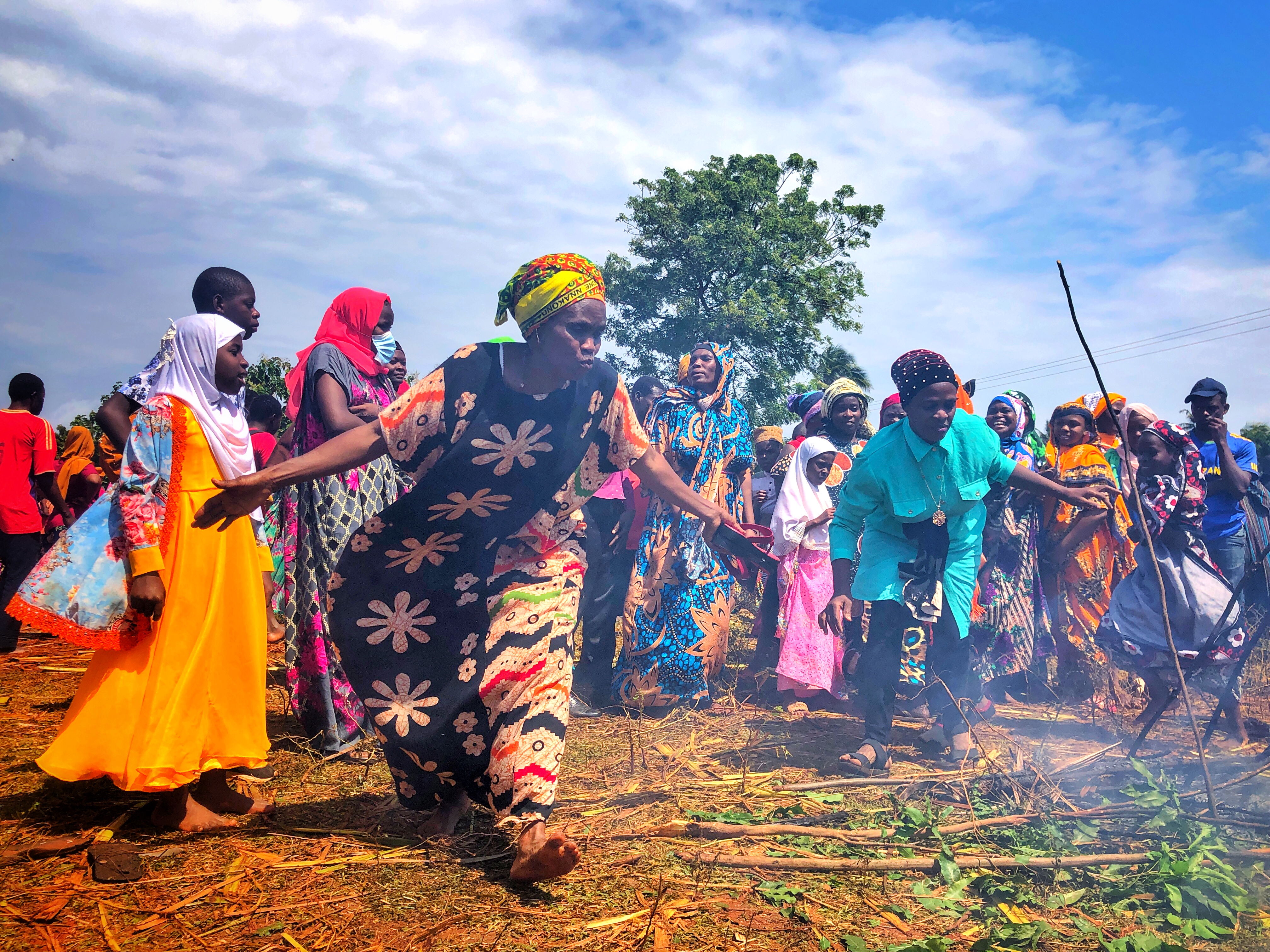
The best-known event is the mock combat. Men from the south of Makunduchi fight men from the north, beating one another with banana stalks. Long ago they used sticks and cudgels. The idea is that everyone vents their anger so the community starts the year without grudges. While the men fight, women walk the field in their finest clothes singing in the local Kikae dialect about love and village life. The day ends with the burning of a small thatch hut and communal feasting, then dancing and taarab music into the night.
Origins & significance
Mwaka Kogwa marks the start of the traditional Swahili solar year. Local tradition traces it to Shirazi settlers and calls it the Persian or Shirazi New Year. Modern scholarship is sceptical. Odile Racine-Issa's fieldwork links the rites to the African ancestor and spirit cult (mizimu), and notes the festival grew from a wider set of agrarian rites meant to secure the help of spirits for the prosperity of the community.
The 'Shirazi' label is widely seen as a constructed coastal identity, not evidence of Persian descent. Over recent decades, the festival has grown in scale and taken on a political role, presented by the government as a link between the islands and mainland Tanzania. Past guests of honour have included retired president Ali Hassan Mwinyi and former OAU Secretary-General Salim Ahmed Salim.
How it's celebrated
Ritual fights with banana stalks, traditional music, dancing, feasting
Households are expected to host a guest, and a home with no guest is said to be unhappy; visitors and strangers are warmly received. The sheha, the government-appointed head of the shehia (local administrative unit), has a ceremonial role and rests in a metal-roofed hut with a Swahili bed beside the field. A large rock at the field is treated as protective, said to stop people falling into a nearby well, and a pole wrapped in new red or white muslin is set up to appease spirits. The Kikae (also called Kihadimu or Kimakunduchi) dialect of southern Unguja is used in the songs. Women do not take part in the fighting. Visitors are welcomed as observers rather than participants.
Plan your visit
The festival is free and open to visitors. Makunduchi is about 50 to 63 km south of Stone Town, roughly one hour by car via the A14.
Dress modestly; Makunduchi is a conservative Muslim village.
Visitors are welcomed as observers, not participants, and do not join the fighting; standing close to the action risks stray banana-stalk blows.
Be respectful when taking photographs. One source mentions a small informal road fee of about 5,000 TZS may be collected on the Jambiani approach, but this is unconfirmed.
The culture
People dress in their finest Swahili clothing.
Women wear the kanga, a printed cotton cloth with three parts: the pindo (border), the mji (central design) and the jina (a Swahili proverb or message).
Men may wear the kanzu, a long robe, with an embroidered cap called a kofia, or a kikoi wrap cloth at the waist. Scented flower posies known as kikuba are used on festive and ceremonial occasions.
Ngoma drumming runs through the day, and taarab, the Swahili sung poetry style that blends African, Arab and Indian influences, is performed in the evening and on the beach into the night.
Traditional Makunduchi dances are performed at the 'Koba' ground in the evening, including Mpe Chungu associated with Mzuri Kaja village and Dandaro associated with Kajengwa village.
Help keep this accurate
Festivals change year to year. If you know this one, from the community or as an organiser, a quick confirmation or correction keeps it right for everyone.
Log in to confirm this festival or suggest a change.
Embed this page on your site
Add a badge that links back to this official festival page.