Tchiloli Festival
A masked theatre, music and dance tradition of São Tomé that re-enacts the medieval trial of Charlemagne's son for murder, staged at patronal feasts.
When it happensTimed by the season, the harvest or the moon, so it drifts by weeks from year to year.
Where it happens
📍 São Tomé island · Bairro da Boa Morte · Madre de Deus · Caixão Grande · Cova Barro · Sao Tome and Principe
Features performances of the traditional Tchiloli drama, combining European medieval theater with African elements
About Tchiloli Festival
Tchiloli is a popular theatre form performed on the island of São Tomé. It stages a single play, the 'Tragédia do Marquês de Mântua e do Imperador Carlos Magno,' written around 1540 by the blind Madeiran playwright Baltasar Dias, from the Charlemagne (Carolingian) story cycle. The plot follows Don Carloto, son and heir of the Emperor Charlemagne, who murders his best friend Valdevinos, nephew of the Marquis of Mantua, out of passion for Valdevinos's wife Sibila. The Mantua family demands justice, and Charlemagne is torn between reason of state and love for his son. In the end Carloto is condemned and executed. Local troupes, called 'tragédias,' perform their own versions in a mix of old and modern Portuguese, blending the European text with dance, mime and music. UNESCO inscribed Tchiloli on the Representative List of the Intangible Cultural Heritage of Humanity in 2025 under the title 'Tchiloli, living theatre of Sao Tome and Principe in the quest of justice.' Scholars led by Gerhard Seibert argue the play reached the island in the late 19th century, not the 16th century as oral tradition claims. The word Tchiloli most likely comes from the Portuguese 'tiroliro,' a fife, after the bamboo flutes played in the show.
Origins & significance
Tchiloli is based on a 16th-century Portuguese play by Baltasar Dias (c.1515–c.1580), drawn from Castilian romances of the medieval Charlemagne cycle. Portuguese navigators reached the uninhabited islands around 1470–1471, and the first lasting settlement came in 1493 under Álvaro de Caminha, using convicts, deported Jewish children and enslaved Africans. About 2,000 Jewish children, some as young as two, were sent to the islands in 1493 and forcibly baptized; most died. From unions of settlers and enslaved African women grew the Forro, the native creoles or 'children of the land.' Oral tradition says Madeiran sugar masters brought the play in the 16th century, but there is no documentary evidence, and researchers including António Ambrósio (1985), Gerhard Seibert, Paulo Valverde and Anna Kalewska argue it was introduced around 1880, during the cocoa and coffee era. The Forro community made the European story its own, and readings such as Christian Valbert's see the imperial court as colonial Lisbon and the wronged Mantua family as the island's mixed-race families demanding justice.
How it's celebrated
A performance runs about six hours, and up to seven or eight, on beaten earth in a yard or public square, open on all sides. On one side a raised platform on wooden stakes, roofed with palm branches, is the imperial 'high court'; opposite, a hut of green branches on the ground is the 'low court' of the mourning Mantua family. A small coffin on a chair in the centre stands for the dead Valdevinos. Actors move between the courts in dance and mime while an orchestra plays. Spectators comment aloud during the scenes. Most of Dias's seven-syllable verse is kept, with added modern Portuguese prose for the trial and legal scenes. Before starting, actors drink palm wine or aguardente to summon the spirits of the performers who held their roles before them.
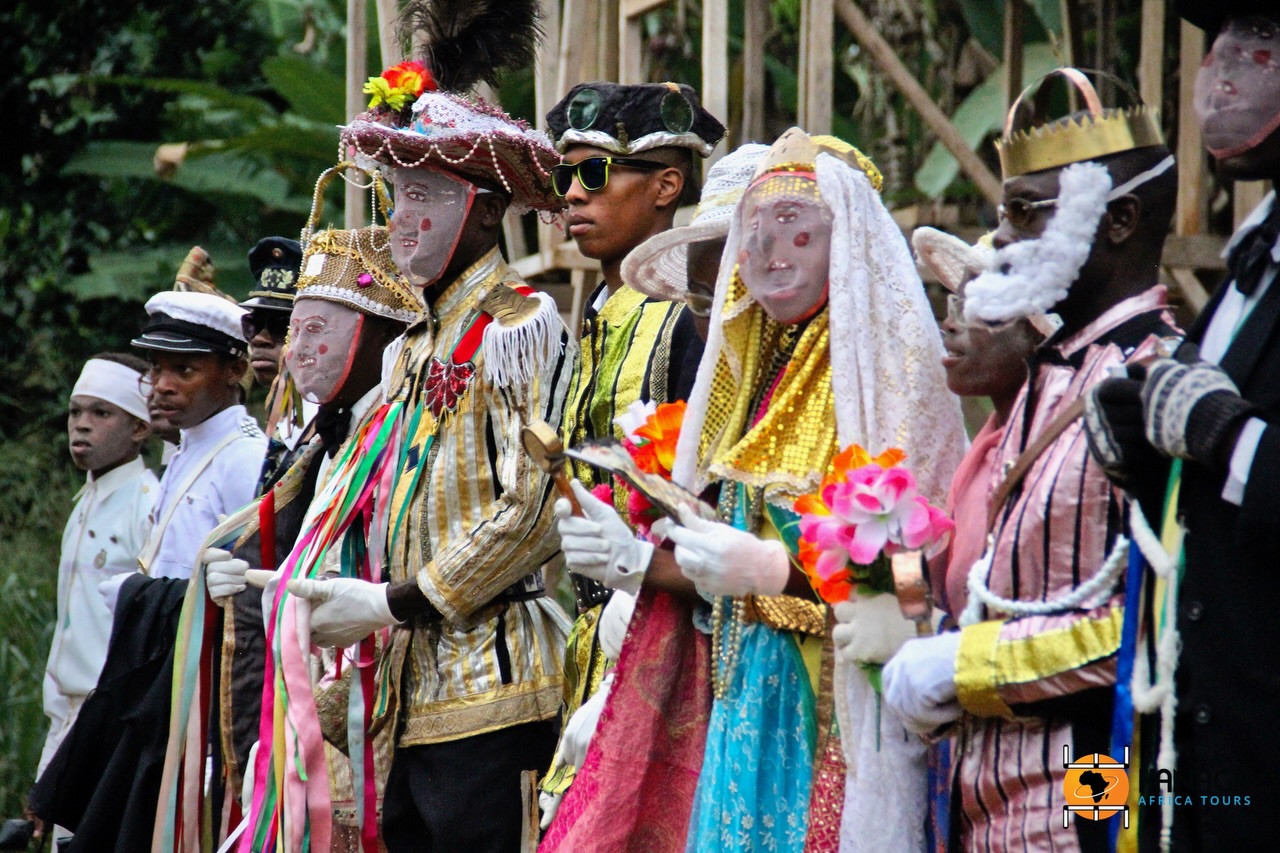
Troupes are called 'tragédias' and belong to particular Forro localities. Roles, costumes and texts pass down within families, and one actor keeps the same character for life. Following medieval custom, all roles including women's are played by men; women have historically played instruments such as the rattle and bell and worked offstage, though since 2018 an all-female troupe, the Txiloli Feminino de Cachoeira, performs in the Mé-Zóchi district of São Tomé. Masks are oval, smaller than the face, made of molded mosquito netting painted white with eyes and mouth drawn on; performers may take them off only after sunset. In the Formiguinha da Boa Morte troupe, Charlemagne and the Minister of Justice wear sunglasses instead of masks.
Plan your visit
Traditional performances take place in the open air at village and neighbourhood patronal feasts during the dry season (about June to September) and are free and public. To find one, ask locals or contact a troupe such as Formiguinha da Boa Morte in the Bairro da Boa Morte in São Tomé. Shortened versions for visitors exist: the Formiguinha group performs condensed shows for tourists, and operators offer curated performances of about 90 minutes. Note that the Auto de Floripes on Príncipe island (15 August, Festa de São Lourenço) is a related but separate tradition.
The culture
Actors wear anachronistic European-style dress: dark frock coats trimmed with multicoloured ribbons and sequins, bicorn hats, white gloves and oval white masks of painted mosquito netting. Modern props mark different powers: military uniforms and gloves for military power; suits, a typewriter, telephone, briefcase and sunglasses for administrative power; student ribbons for learning.
Music is provided by an orchestra of drums of various sizes, a bell (sino), bamboo transverse flutes and 'sucalos, ' local rattles made from a small basket holding seeds. The music is characteristically monotone, with a single melody repeated as the actors dance back and forth.
The whole play is a blend of dance and mime, with the actors dancing between the two courts. Ethnographer Tomaz Ribas linked the African-rooted choreography to the danço-Congo, a Santomean dance-theatre form.
Help keep this accurate
Festivals change year to year. If you know this one, from the community or as an organiser, a quick confirmation or correction keeps it right for everyone.
Log in to confirm this festival or suggest a change.
Embed this page on your site
Add a badge that links back to this official festival page.