Picture this: It's 1962 in Bangui.
Children play football in dusty streets. Women carry water from the Ubangi River. Market vendors sell cassava and dried fish.
In the recently independent nation, life continues as it has for generations.
That same year, thousands of kilometres away in Paris, two French scientists publish a paper that should have made headlines across Africa.
They've discovered something extraordinary: beneath the feet of ordinary Central Africans lies one of the most powerful magnetic forces on Earth.
An invisible giant so massive that satellites can see it from space.
This is the story of the Bangui Magnetic Anomaly.
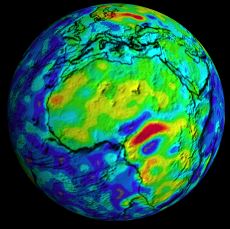
Image 1: Nasa’s CM3 model prediction showing high magnetisation (red) over the Central African Republic
Let's start with what makes this discovery so mind-blowing.
Imagine Earth as a Giant Magnet (Because It Is)
Before we go any further, let's talk about magnetism.
You know how your phone's compass always points north?
That's because Earth itself is a giant magnet. Deep inside our planet, hot liquid iron swirls around, creating magnetic fields that shoot out through the ground beneath your feet and extend into space.
These magnetic fields help migratory birds navigate thousands of kilometres during migration.
They're why sailors could navigate oceans for centuries using simple compasses.
They're invisible, but they're everywhere.
Now here's where it gets interesting:
Most places on Earth have relatively calm magnetic fields, like a gentle stream flowing steadily.
But in a few spots, something beneath the ground creates massive disturbances, like a waterfall crashing through that stream.
The Bangui Magnetic Anomaly is one of those waterfalls.
Video 1: Visualisation of Earth's Magnetosphere
The Numbers That Shocked Scientists
Let me give you some context with a story:
In the 1970s, an American geologist named Bruce Marsh travelled to what was then called the Central African Empire (yes, under Emperor Bokassa - story for another day) to measure this magnetic anomaly.
What he found was staggering:
The magnetic disturbance is so strong that if you measured it at ground level, your equipment would register forces 1,000 times more powerful than normal. Even from space, 400 kilometres up, where satellites orbit, instruments still detect the disturbance.
The area affected? 700 by 1,000 kilometres. That's roughly the size of Nigeria. Or three Ugandas stacked together.
The Mystery No One Can Solve
Here's where our story becomes a scientific detective thriller with no ending.
THEORY ONE: The Scar of an Ancient Catastrophe
Some scientists believe that over a billion years ago, long before dinosaurs, before trees, before anything you'd recognise as life, a massive rock from space slammed into Central Africa.
Not a small meteorite. A monster one. The kind that creates extinction events.
When such impacts happen, they don't just make craters. They melt rock, magnetise minerals, and leave scars that last for billions of years.
Scientists who believe this theory point to something fascinating: when they look at satellite images, they can see two giant rings. One 490 kilometres across, another 810 kilometres across, surrounding Bangui.
Perfect circles. Like ripples frozen in stone.
THEORY TWO: Ancient Rocks, Not Space Rocks
Other scientists argue that what we're seeing is simply very old, very iron-rich rock formations buried deep in the Earth's crust between 15 and 38 kilometres down.
These rocks, they say, formed naturally when Africa's continents collided hundreds of millions of years ago, squeezing iron-rich materials into the ground like toothpaste into a tube.
The evidence? Recent studies by scientists have found patterns in the magnetic readings that match exactly with the kinds of rocks you'd expect from continental collisions. Not meteor impacts.
THE PROBLEM: Both Sides Have Evidence. Neither Can Prove It.
You know what would prove a meteor impact? Finding shocked rocks that show the telltale signs of being hit by something travelling faster than a bullet. Scientists have looked. They haven't found any.
But on the other hand, you know what would disprove the meteor theory? Explaining those perfect circular rings without an impact. Geologists haven't managed that either.
So the mystery remains unsolved, one of the biggest geological puzzles on the African continent.
Video 2: ESA's Sentinel-5P satellite captures the Bangui Magnetic Anomaly. CREDIT ESA/DTU Space/DLR
The Heartbreaking Disconnect
Remember those French scientists in 1962? The American researchers in the 1970s? The satellite missions in the 1980s and beyond?
Not one of them was accompanied by a Central African scientist.
The phenomenon was discovered by foreigners, named by foreigners, studied by foreigners, and written about in journals published in Paris, Washington, and London.
Today, you can find hundreds of scientific papers about the Bangui Magnetic Anomaly.
You know how many are written in Sango, the national language of the Central African Republic? Zero.
You know how many rural Central Africans have heard of it? Almost none.
I spent time researching local stories, myths, and legends from the region. The Banda people have beautiful traditions about ancestral spirits. The Gbaya people have elaborate initiation ceremonies. The Baka communities possess incredible knowledge about forest ecology.
But magnetic anomalies? Invisible force fields? Not a single story. Not one legend. Nothing.
Because how do you create stories about something you cannot see, touch, or feel?
The Gold Beneath Your Feet (Literally)
You know what else is invisible but incredibly valuable? The connection between this magnetic anomaly and the region's mineral wealth.
The Central African Republic exports $100-150 million worth of diamonds and gold every year.
The region also contains massive iron ore deposits. We're talking about 500 million tonnes of iron ore at just one location alone.
Now here's the connection scientists recently discovered: Those iron-rich rocks causing the magnetic anomaly are directly related to the mineral deposits miners are extracting.
The same geological forces that created this invisible magnetic giant also brought valuable minerals close enough to the surface for people to find them. The anomaly and the mineral wealth are two sides of the same ancient geological story.
But ask any artisanal miner in Bangui about the magnetic anomaly? Blank stares.
Why You Should Care
I know what you're thinking: \"This is all very interesting, but I can't see it, I can't touch it, and I can't visit it because of security concerns in CAR. So why should I care?\"
Because stories matter. And Africa deserves to tell more of its own stories.
For too long, Africa's natural wonders have been discovered by outsiders, studied by outsiders, and explained to the world by outsiders. The Bangui Magnetic Anomaly is just one example, but it's a perfect example.
A phenomenon that belongs to Africa, sits beneath African soil, and affects African communities has become a footnote in foreign scientific journals that most Africans will never read.
That can change.
Imagine if every African school child learned about the Bangui Magnetic Anomaly the way they learn about Mount Kilimanjaro or Victoria Falls.
The Compass Rose
I'll leave you with a thought:
Somewhere above Central Africa right now, satellites are circling the Earth. As they pass over Bangui, their instruments detect that familiar disturbance; negative 22 nanoteslas, steady as always, powerful as always.
The invisible giant keeps pulsing, keeps disrupting, keeps existing. Whether anyone notices or not.
But now you know it’s there.
Back in Bangui, children still play football in dusty streets. Women still carry water from the Ubangi River. Life continues as it has for generations. But now, when you think of that place, you’ll think of something more than headlines about conflict or poverty.
And maybe, just maybe, knowing that changes something.
Join the Lughayangu Community!