Sooner or later, most countries face the same question:
What language represents the nation?
Somalia chose Somali.
Nigeria chose English.
Tanzania chose Swahili.
Even countries with dozens of languages usually pick one or two to serve as the official voice of the state.
Eritrea did something different.
It chose none.
The Constitution of Eritrea does not name a single official language. Instead, it makes a striking promise:
“The equality of all Eritrean languages is guaranteed.”
This is unusual anywhere in the world.
Eritrea is home to nine ethnic groups, each with its own language. These languages belong to three entirely different language families and are written using three different scripts: the ancient Ge’ez script, the Arabic script, and the Latin alphabet.
In a single country, street signs, schoolbooks, and radio broadcasts may appear in three different writing systems.
Yet none of them holds official status above the others.
Why would a country deliberately refuse to choose an official language?
To answer that question, we have to go back to the beginning of Eritrea itself.
A Small Strip of Land That Shaped Empires
Eritrea sits along the western edge of the Red Sea in the Horn of Africa.
On a map, it looks like a narrow strip of land wedged between Sudan, Ethiopia, and Djibouti. But this small stretch of coastline hides enormous strategic importance.
Just across the water lies the Bab el-Mandeb Strait, the narrow passage connecting the Red Sea to the Gulf of Aden. Today, nearly ten per cent of global maritime trade passes through this corridor.
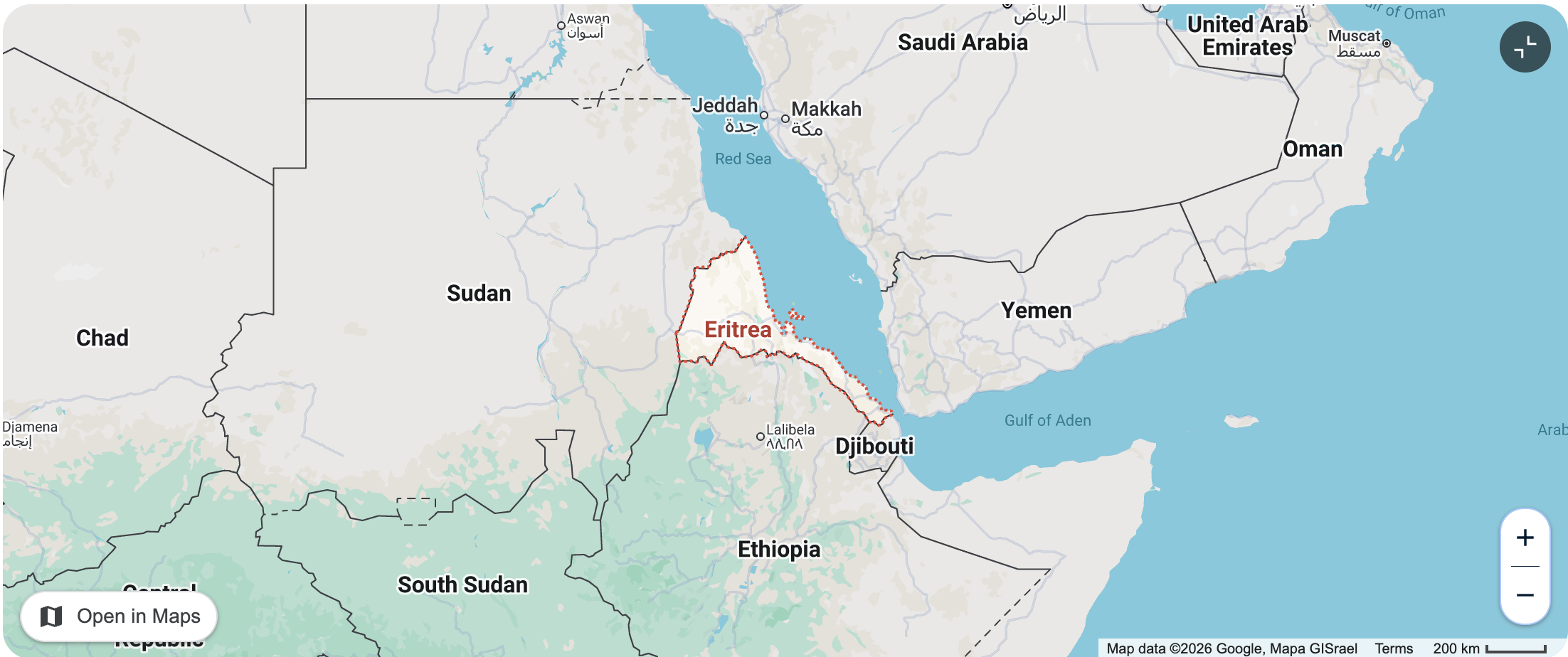
Image 1: Map of Eritrea Source: Google Maps
For thousands of years, ships moving between the Mediterranean, Arabia, India, and East Africa passed through these waters.
Whoever controlled this coastline controlled one of the world’s great trade routes.
It is no surprise that powerful empires were drawn here again and again.
Long before the modern nation of Eritrea existed, this land formed part of one of Africa’s earliest and most influential civilisations.
Archaeologists have uncovered evidence of the ancient kingdom of D’mt, which flourished here nearly three thousand years ago. Its people built temples, used irrigation systems, and produced iron tools at a time when much of the surrounding region remained pastoral.
From these early foundations emerged the powerful Aksumite Empire.
By the first centuries of the Common Era, Aksum had become one of the great trading powers of the ancient world. The Persian prophet Mani once ranked it alongside Rome, Persia, and China as one of the four great empires of his time.
The engine of that power was a port city called Adulis, located along what is now Eritrea’s coastline.
From Adulis, merchants exported ivory, gold, incense, and exotic animals across the Red Sea and beyond. Roman glassware, Persian goods, and Indian textiles flowed back in return.
For centuries, this coastline served as one of the gateways linking Africa to the wider world.
But the name “Eritrea” did not yet exist.
And the people who lived here did not yet imagine themselves as citizens of a single country.
That idea would only appear much later, when European colonial ambitions reached the Red Sea.
When Italy Created Eritrea
For most of history, the land that now forms Eritrea was tied to the political world of the Ethiopian highlands.
But in the late nineteenth century, a new force arrived on the Red Sea coast.
Italy.
The story began in 1869, the same year the Suez Canal opened. The canal transformed the Red Sea into one of the busiest maritime corridors in the world. Suddenly, European powers became eager to secure ports along the route.
An Italian missionary named Giuseppe Sapeto purchased a small piece of land at the port of Assab on behalf of an Italian shipping company. At first, the acquisition seemed minor, just a foothold on the coast.
But Italy had larger ambitions.
In 1885, Italian forces occupied the important port of Massawa, taking advantage of a power vacuum left by the weakening Ottoman and Egyptian presence in the region.
Events moved quickly from there.
In 1889, Ethiopia’s new emperor, Menelik II, signed the Treaty of Wuchale with Italy. The treaty recognised Italy’s control over the coastal territories.
The following year, on January 1, 1890, Italy officially declared the Colony of Eritrea.
For the first time in history, the territory had both a defined border and a single political identity.
Even the name was new.
“Eritrea” came from the Greek phrase Erythra Thalassa, meaning “Red Sea.”
What had once been a collection of regions, communities, and trade routes was now a colonial state drawn on a European map.
Italy hoped this colony would serve as the foundation for a larger African empire.
That ambition collapsed dramatically a few years later.
In 1896, Ethiopian forces defeated the Italian army at the Battle of Adwa, one of the most decisive defeats of a European colonial power in Africa.
After Adwa, Italy abandoned its plans to conquer Ethiopia. But it retained control of Eritrea.
And within that colony, the Italians began building something entirely new.
The Italian Colony and the Birth of Asmara
Over the next fifty years, Eritrea became Italy’s most developed colony in Africa.
The Italians invested heavily in infrastructure.
They built railways linking the coast to the highlands.
They expanded the ports of Massawa and Assab.
Factories, roads, and telecommunications networks appeared across the territory.
But the most striking transformation took place in a highland town called Asmara.
Under Italian rule, Asmara was redesigned as a modern colonial capital. Between the 1930s and early 1940s, Italian architects turned the city into a laboratory for modernist architecture.
Within just a few years, hundreds of new buildings appeared.
Cinemas.
Boulevards.
Gas stations shaped like aeroplanes.
One of the most famous structures was the Fiat Tagliero Building, a futuristic gas station with dramatic concrete wings extending fifteen meters into the air.
By the late 1930s, tens of thousands of Italians lived in Eritrea, and Asmara had become one of the most modern cities on the continent.
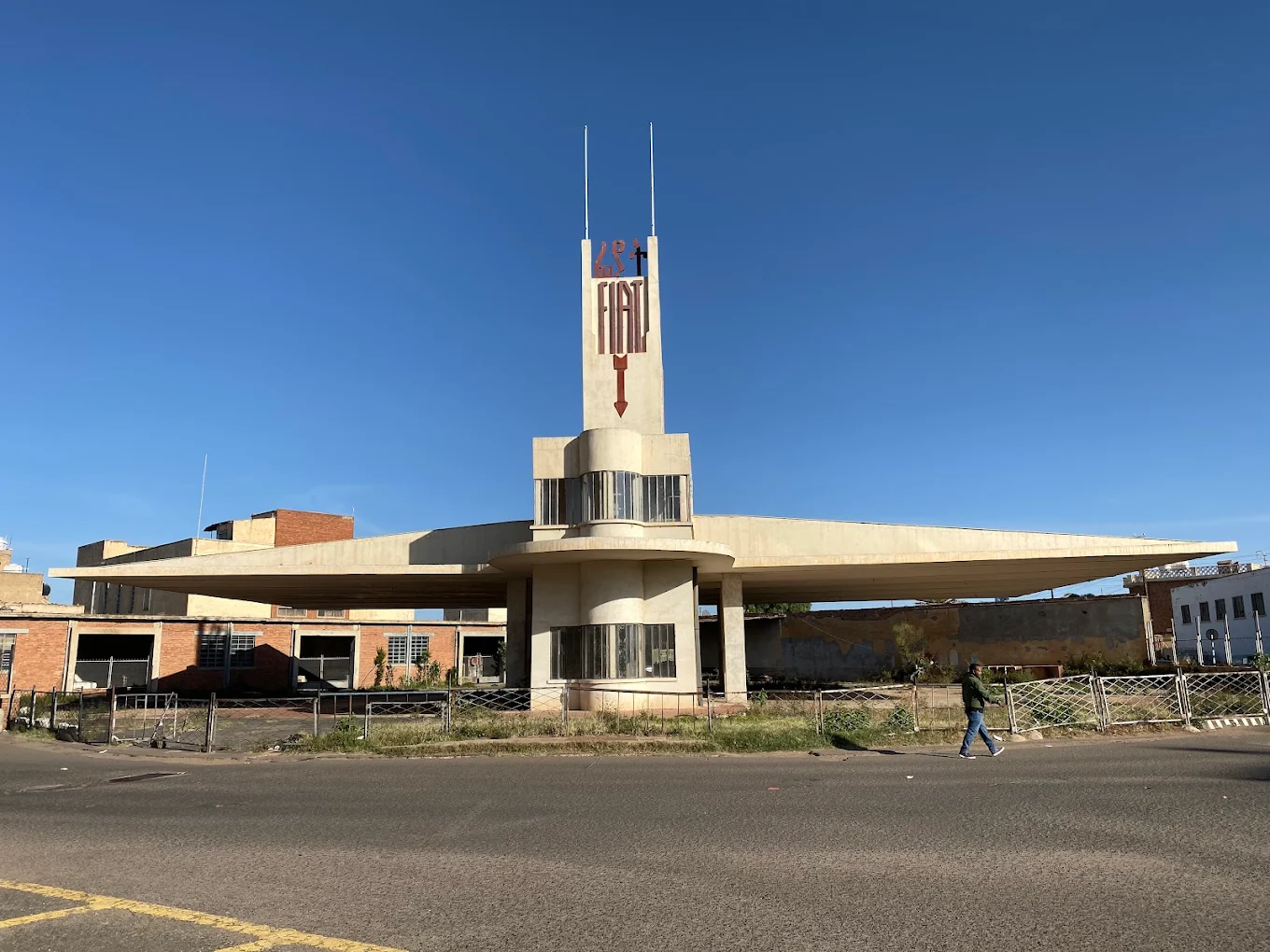
Image 2: A photo of Fiat Tagliero
Italy also used Eritrea as the launchpad for its invasion of Ethiopia in 1935, deploying both Italian soldiers and Eritrean colonial troops.
For a brief moment, Mussolini believed he had created a new Roman-style empire in East Africa.
But the empire did not last.
During World War II, British forces defeated the Italians and entered Asmara in 1941, ending more than fifty years of Italian rule.
Once again, the future of Eritrea was uncertain.
That uncertainty would soon lead to one of the most consequential decisions in the region’s history.
Federation, Betrayal, and a Broken Promise
Eritrea was placed under a British Military Administration.
For more than a decade, the British governed the region while the international community debated its fate.
Several proposals emerged.
Some believed Eritrea should become an independent country.
Others argued that the territory should be divided between Sudan and Ethiopia.
Ethiopia itself pushed strongly for annexation.
The debate quickly drew in the politics of the Cold War.
For the United States and its allies, Ethiopia was an important strategic partner in the region. American policymakers worried that a fully independent Eritrea might destabilise the Horn of Africa.
In 1950, the United Nations attempted a compromise.
Under UN Resolution 390, Eritrea would not become fully independent. Instead, it would be federated with Ethiopia as an autonomous unit.
When the federation took effect in 1952, Eritrea retained significant powers.
It had its own parliament.
Its own constitution.
Its own flag.
Two languages, Tigrinya and Arabic, were recognised for official use within the federation.
On paper, the arrangement was meant to balance Eritrean autonomy with Ethiopian sovereignty.
But the balance did not last.
Ethiopian emperor Haile Selassie soon began dismantling the federation piece by piece.
Political parties were banned.
Trade unions were dissolved.
Amharic replaced local languages in schools.
By 1962, the Eritrean parliament, under intense pressure, voted to dissolve the federation altogether. Eritrea was formally annexed and turned into Ethiopia’s fourteenth province.
For many Eritreans, this was not a legal transition.
It was the end of a promise.
And it would spark a war that would last for three decades.
The Thirty-Year War
The first shots of the Eritrean independence struggle were fired on September 1, 1961.
On that day, a small group of fighters led by Hamid Idris Awate attacked Ethiopian forces near Mount Adal.
The act marked the beginning of what would become one of the longest wars in African history.
At first, the rebellion was small. But over time, it grew into a broad liberation movement.
Two major organisations emerged.
The Eritrean Liberation Front (ELF) led the early phase of the struggle, drawing much of its support from Muslim communities in the lowlands.
Later, a breakaway movement known as the Eritrean People’s Liberation Front (EPLF) became the dominant force in the war.
The conflict intensified during the Cold War.
In 1974, a Marxist military regime known as the Derg seized power in Ethiopia. The Soviet Union quickly became its primary ally, supplying massive amounts of military aid.
At the height of the war, Ethiopia received billions of dollars in Soviet weapons, along with Cuban military support.
Against this formidable force, the Eritrean fighters retreated into the mountains of northern Eritrea.
There, around the town of Nakfa, they built one of the most remarkable resistance strongholds in modern warfare.
Hidden beneath the mountains were hospitals, workshops, schools, and communication centres. Hundreds of underground structures were connected by trenches stretching for kilometres.
Even under relentless offensives by Ethiopian forces, the resistance held.
The war also transformed Eritrean society.
Women made up nearly a third of the liberation army, serving as fighters, commanders, medics, and mechanics.
After decades of fighting, the balance finally shifted.
In 1988, Eritrean forces won a decisive victory at the Battle of Afabet, destroying one of Ethiopia’s major military commands.
Two years later, they captured the port city of Massawa.
By 1991, the Ethiopian government itself was collapsing.
That year, Eritrean fighters entered the capital, Asmara, to jubilant crowds.
The war was over.
But the cost had been immense.
Tens of thousands of Eritreans had died. Hundreds of thousands had been displaced. Nearly an entire generation had grown up under the shadow of conflict.
In 1993, Eritreans were finally able to vote on their future.
In a referendum supervised by the United Nations, 99.83% of voters chose independence.
On May 24 of that year, Eritrea officially became a sovereign state.
But independence raised a new challenge.
The country had fought together as one people.
Now it had to decide how to build a nation.
And one of the most sensitive questions was language.
Nine Peoples, Nine Tongues
Nine recognised ethnic groups live within Eritrea, each with its own language and cultural history.
The largest group are the Tigrinya, who make up just over half of the population. Their language, also called Tigrinya, is spoken by roughly 2.5 million Eritreans and is written using the ancient Ge’ez script, one of Africa’s oldest writing systems. Most Tigrinya speakers live in the cool central highlands around the capital, Asmara.
Closely related but entirely distinct are the Tigre people, who form the second-largest community in the country. Around one million Eritreans speak Tigre, primarily across the northern and western lowlands. Like Tigrinya, their language descends from the ancient Ge’ez tradition, but the two languages are not mutually intelligible.
Along the eastern foothills and coastal regions live the Saho, whose Cushitic language is spoken by nearly two hundred thousand people. Further south, in the harsh deserts of the Danakil Depression, the Afar people maintain their own closely related Cushitic language and semi-nomadic traditions.
Around the city of Keren live the Bilen, speakers of a Central Cushitic language that traces its roots to the Agaw languages of Ethiopia. Their community is notable for being almost evenly divided between Islam and Christianity.
In the northwestern plains, the pastoralist Hedareb people speak Beja, a language so unique that it forms its own branch within the Afro-Asiatic language family.
Further west live two of Eritrea’s most distinctive linguistic communities: the Kunama and the Nara. Their languages belong to the Nilo-Saharan family and differ significantly from the Semitic and Cushitic languages spoken elsewhere in the country.
The smallest recognised community are the Rashaida, a group of Arabic-speaking Bedouins who migrated from the Arabian Peninsula in the nineteenth century and settled along Eritrea’s northern coast.
Taken together, these nine people represent a remarkable diversity for a country of Eritrea’s size.
For the leaders of the new nation, this diversity raised a difficult question.
If Eritrea was now one country, which of these languages should represent it?
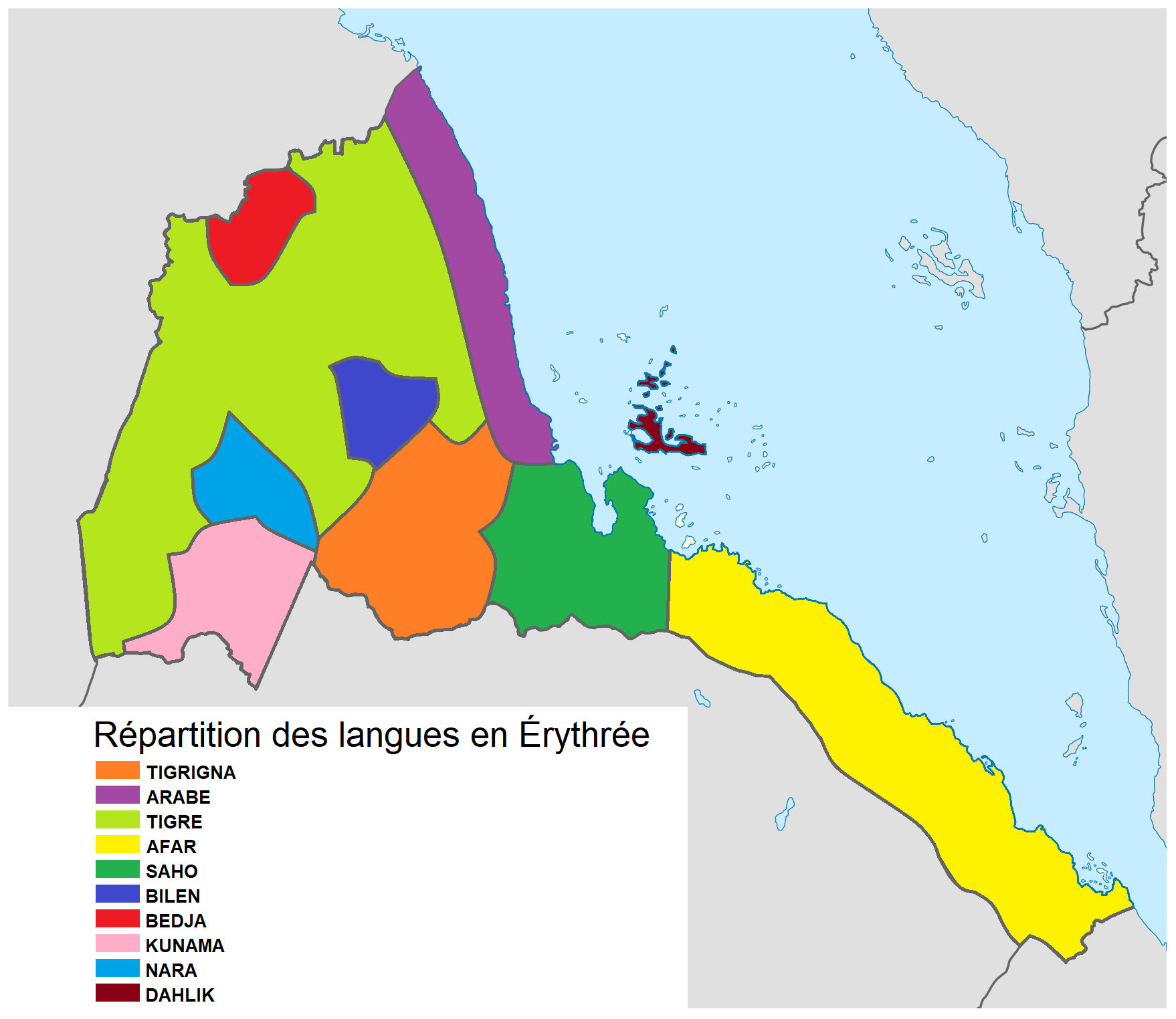
Image 3: Colored map of Eritrean languages and where they are spoken. By MuntjacPassionné - Own work, CC BY-SA 4.0,
The Language Dilemma
The answer was not obvious.
During the thirty-year war for independence, fighters from different regions, religions, and ethnic groups had united under a single cause. But once the war ended, those differences still existed.
Many Tigrinya-speaking communities in the highlands were Christian, while many lowland communities, including speakers of Tigre, Saho, and Afar, were Muslim.
Language, geography, and religion had long formed a delicate balance.
Choosing one language as the official language of the new country risked upsetting that balance.
If Tigrinya, the most widely spoken language, were declared official, some communities might see it as dominance by the highlands.
If Arabic were elevated, others might interpret it as an attempt to align the country more closely with the Arab world.
Even choosing two or three official languages could create competing political blocs.
So when Eritrea began drafting its constitution, the language question quickly became one of the most sensitive issues on the table.
Several proposals were debated.
Some delegates supported recognising Tigrinya and Arabic together, reflecting the earlier arrangement during Eritrea’s federation with Ethiopia.
Others argued that Tigre, spoken by the country’s second-largest group, should also be included.
But another idea gradually gained support.
What if the state simply refused to elevate any language above the others?
The Decision to Choose None
In the end, Eritrea adopted one of the most unusual language policies in the world.
The constitution avoided naming any official language at all. Instead, it declared a simple principle:
“The equality of all Eritrean languages is guaranteed.”
The reasoning was straightforward.
If no language was officially superior, no ethnic group could claim linguistic ownership of the state. In theory, every Eritrean language would stand on equal footing.
The idea also reflected the philosophy of the Eritrean People’s Liberation Front, the movement that had led the independence struggle.
During the war, the EPLF had worked to build a national identity that crossed ethnic and religious lines.
Elevating a single language could reopen those divisions.
So Eritrea chose something unusual: linguistic neutrality.
Most countries try to build unity through a shared language.
Eritrea tried to build unity by refusing to choose one.
One Country, Three Scripts
The result is a linguistic landscape unlike almost anywhere else.
Across Eritrea, multiple languages coexist in daily life.
Children are typically taught in their mother tongue during the early years of primary school, helping each community preserve its language.
From secondary school onward, English becomes the main language of instruction.
In government and public life, Tigrinya, Arabic, and English often function as practical working languages.
The diversity is also visible in writing.
Three different scripts appear across the country:
- Ge’ez script, one of Africa’s oldest writing systems, used for languages such as Tigrinya and Tigre
- Arabic script, connected to centuries of Islamic scholarship and trade
- Latin script, adopted for several other Eritrean languages in the modern era
Walk through many Eritrean towns, and you may see all three scripts appearing side by side on street signs, shop fronts, and official documents.
Few countries in the world operate with such a mixture.
Unity Without a Single Language
In practice, not all languages carry equal weight.
Tigrinya dominates much of government administration and everyday urban life, particularly in the capital, Asmara. Arabic remains influential in religious institutions, trade networks, and among Muslim communities.
President Isaias Afwerki has governed Eritrea since its independence in 1993, without national elections or a functioning constitution. The constitution drafted in 1997, the same document that guarantees the equality of all Eritrean languages, has never been fully implemented.
As a result, language policy operates less through constitutional law and more through political institutions.
While all nine languages are recognised symbolically in schools, broadcasting, and cultural life, power in government and the military remains largely centred around Tigrinya.
Critics, particularly among opposition groups in exile, argue that the idea of “equal languages” can sometimes function less as a policy of inclusion and more as a way of avoiding the political debate over whether Arabic should share formal status with Tigrinya.
In that sense, Eritrea’s language question is not only about linguistics.
It reflects the deeper balance between religion, region, and political power that has shaped the Horn of Africa for centuries.
And so Eritrea remains one of the world’s most unusual linguistic experiments.
Whether the country’s language policy represents a genuine model of multilingual coexistence or a carefully managed political compromise is still an open question.
But in a world where language has often divided nations, Eritrea chose a different path.
It chose, quite deliberately, not to choose.
Join the Lughayangu Community!