Across Africa, animals are more than just animals.
They are symbols.
They are messengers.
Sometimes… they are family.
In East Africa, the lion represents royalty. In parts of West Africa, the leopard represents ancestral power.
But on the misty slopes of Mount Cameroon, the Bakweri people share something even deeper.
They believe a man can share his life… with an elephant. Not symbolically. But spiritually.
To members of the Malle Society, every initiated man has a twin in the forest; an elephant that carries part of his soul.
If that elephant is harmed, the man may fall sick. If the elephant dies… the man may die too.
And once every year, this bond comes alive.
Through a ceremony known as Veambe (The Steps of the Elephant).
But this story does not begin with a ceremony.
It begins with a man who lost everything.
The Gambler Who Walked Into the Forest
According to folklore, long ago, there lived a wealthy man named Lisonge Maytey.
Lisonge loved gambling. And for a long time, luck favored him.
Wealth flowed easily. People admired him.
But luck can change quickly.
One day, Lisonge lost everything.
His land.
His wealth.
Even his wives.
Ashamed and broken, Lisonge fled into the forest near Mount Cameroon.
Days, weeks and years passed.
The villagers searched at first, but eventually, they stopped, believing the forest had swallowed him.
But deep in the silence of the jungle, Lisonge experienced something extraordinary.
He later claimed his ancestors appeared to him… not as humans, but as towering elephants.
They taught him sacred knowledge, rituals and even showed him how humans and animals could share one spiritual life.
Years later, Lisonge returned.
He was no longer the same man.
He spoke of living two lives at once. One in the village, and another in the forest, in the form of an elephant.
He emerged years later not as a beggar, but as a patriarch, teaching that a man could live two lives at once: one as a villager, and one as a shadow moving through the forest in the skin of a tusker.
When he settled and gathered his followers, he formed the Malle Society (Maale meaning a gathering of villages)
The Sacred Pact
Members of the Malle Society believe each of them is spiritually tied to an elephant in the wild.
This belief created something powerful. Protection.
Because if a hunter killed an elephant, a man could die too.
This blood-bond turned the Bakweri men into the ultimate protectors of the forest.
They protected elephants.
They respected nature.
They preserved balance.
To celebrate this union, they perform the Veambe (The Steps of the Elephant), a two-day ceremony of drums, dance, and ancestral memory.
When the Village Becomes a Forest
On the morning of the ceremony, the village begins to transform.
Drums echo across the hills.
The scent of crushed leaves fills the air.
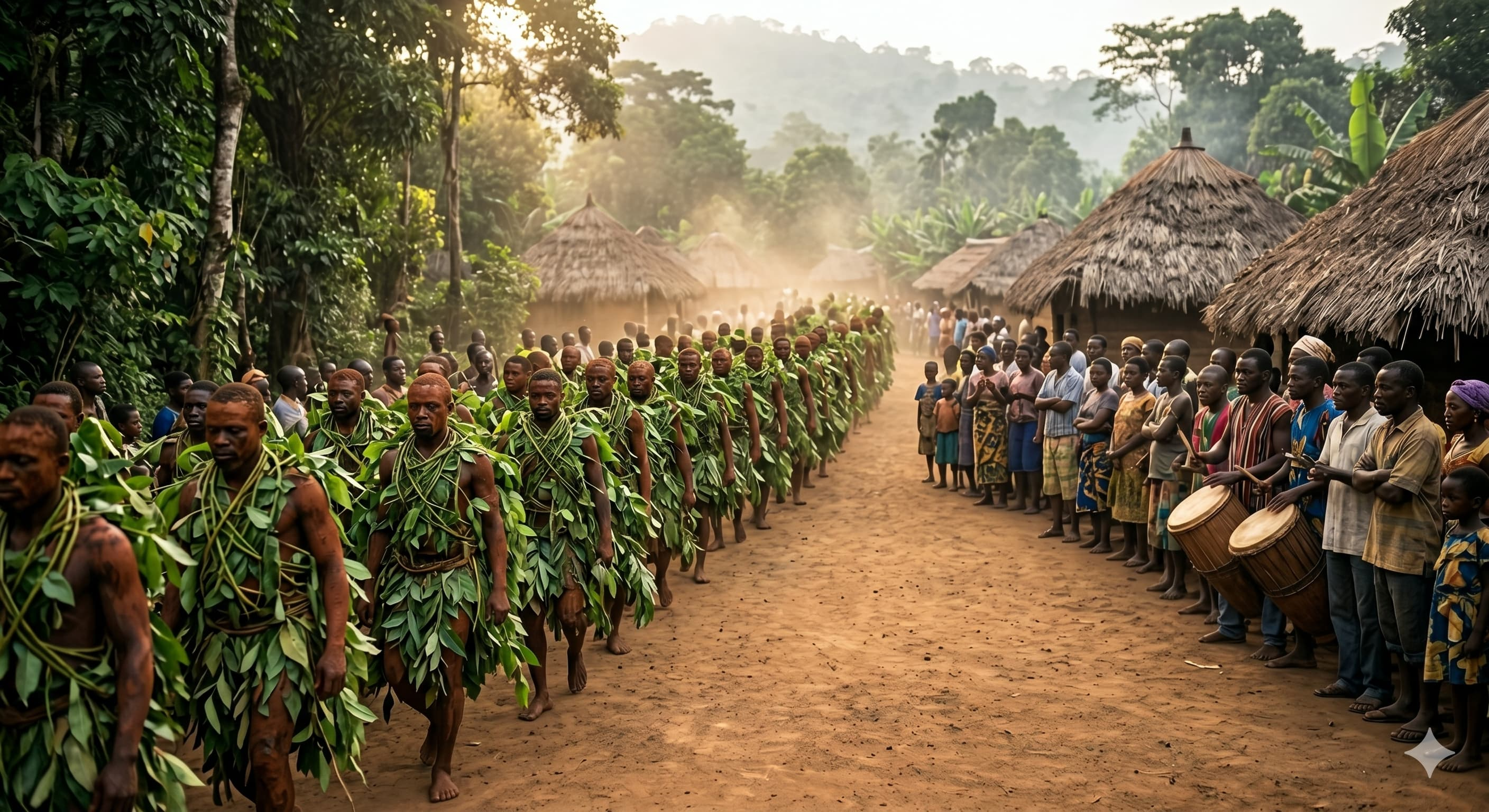
Then the procession begins.
Men emerge, their bodies covered in red earth.
They wrap themselves in green leaves and tree branches, and fresh leaves.
Together, they move slowly in a long line.They sway gently, imitating a herd of elephants moving through thick bush.
From a distance, they no longer look like men. They look like… walking forests.
Villagers watch in silence as the forest seems to step into the village.
The Elephants Arrive
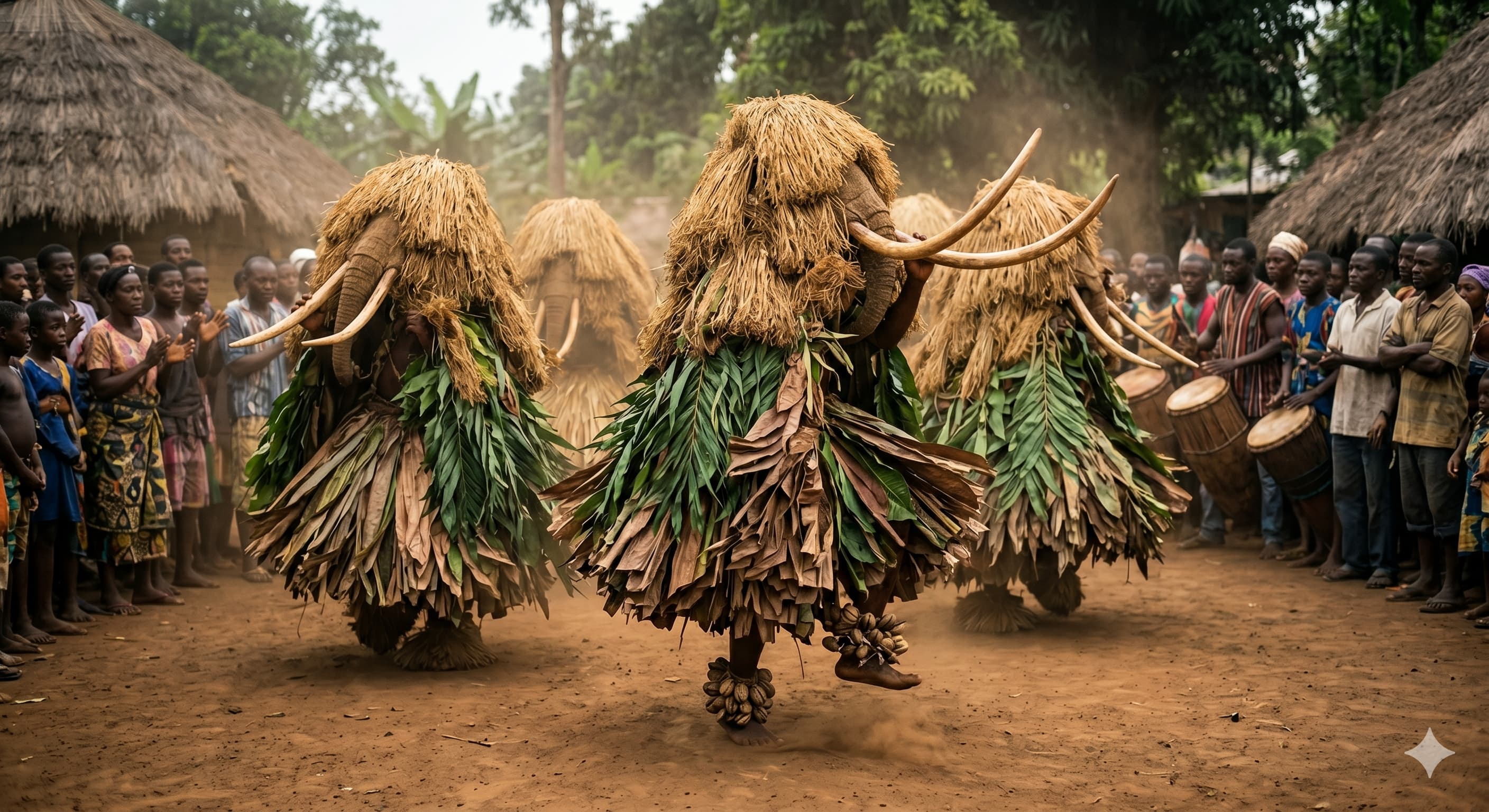
Then the Njoku(the elephant dancers) appear.
Their bodies are hidden beneath massive skirts made of palm leaves.
Their heads are covered with tall raffia hoods.
Long wooden tusks extend outward.
With each step, they stamp heavily into the earth.
Strings of lisonjo (nut shells) tied to their ankles rattle and clank.
The sound echoes like elephants moving through the forest.
They sway, turn and lift their tusks dramatically.
For a moment, it feels like real elephants have arrived.
The Ritual Hunt
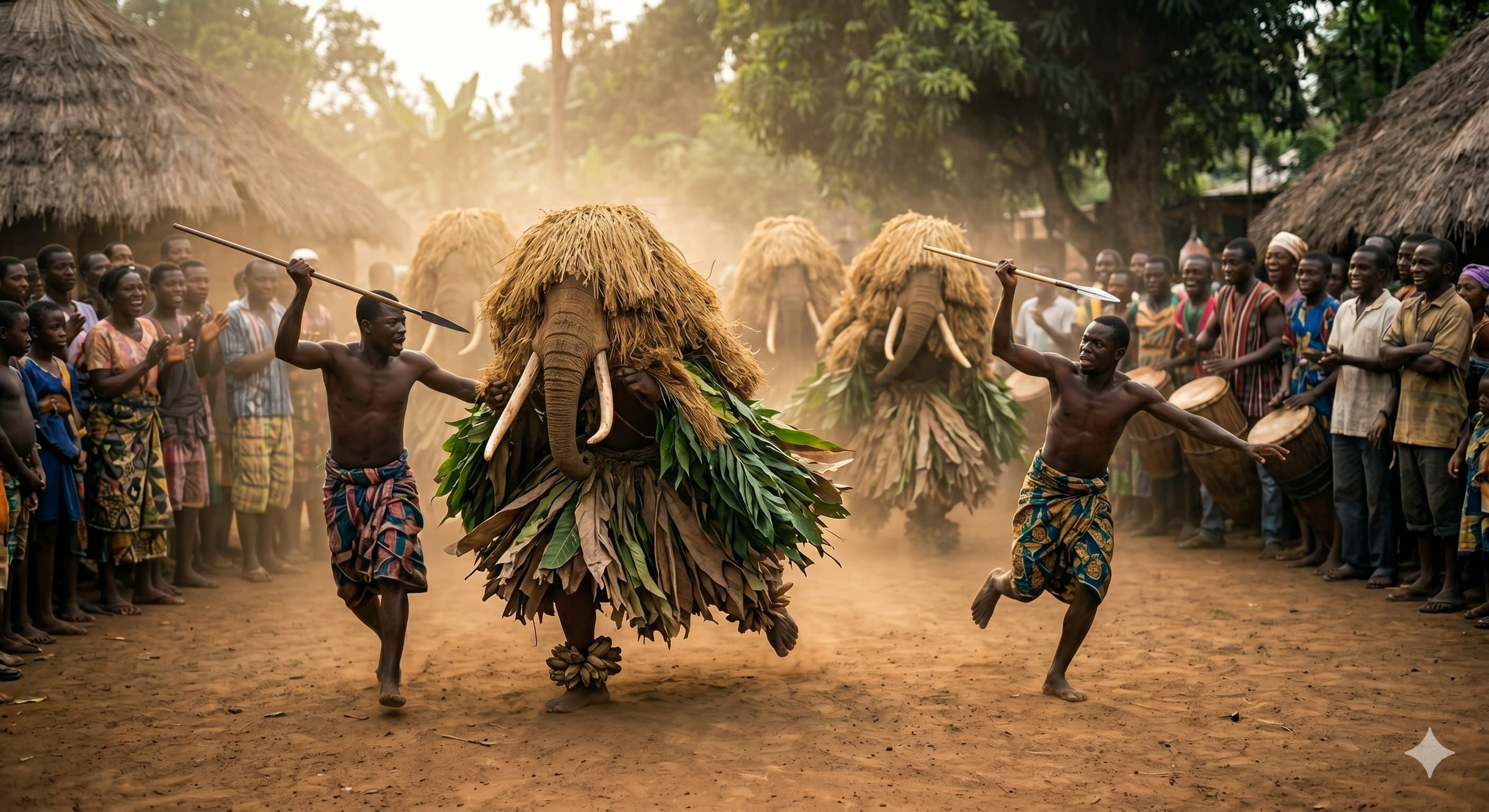
Suddenly, hunters enter the scene.
They carry spears and move cautiously.
They stalk the elephants.
The crowd watches in suspense.
Then the elephants charge: Hunters scatter.
Laughter and excitement fill the air.
Again, the hunters return.
Again, the elephants charge.
This dramatic dance repeats; a story of survival, power, and balance between humans and nature.
The Two Guardians of the Ceremony
The Veambe ceremony is guided by two special figures.
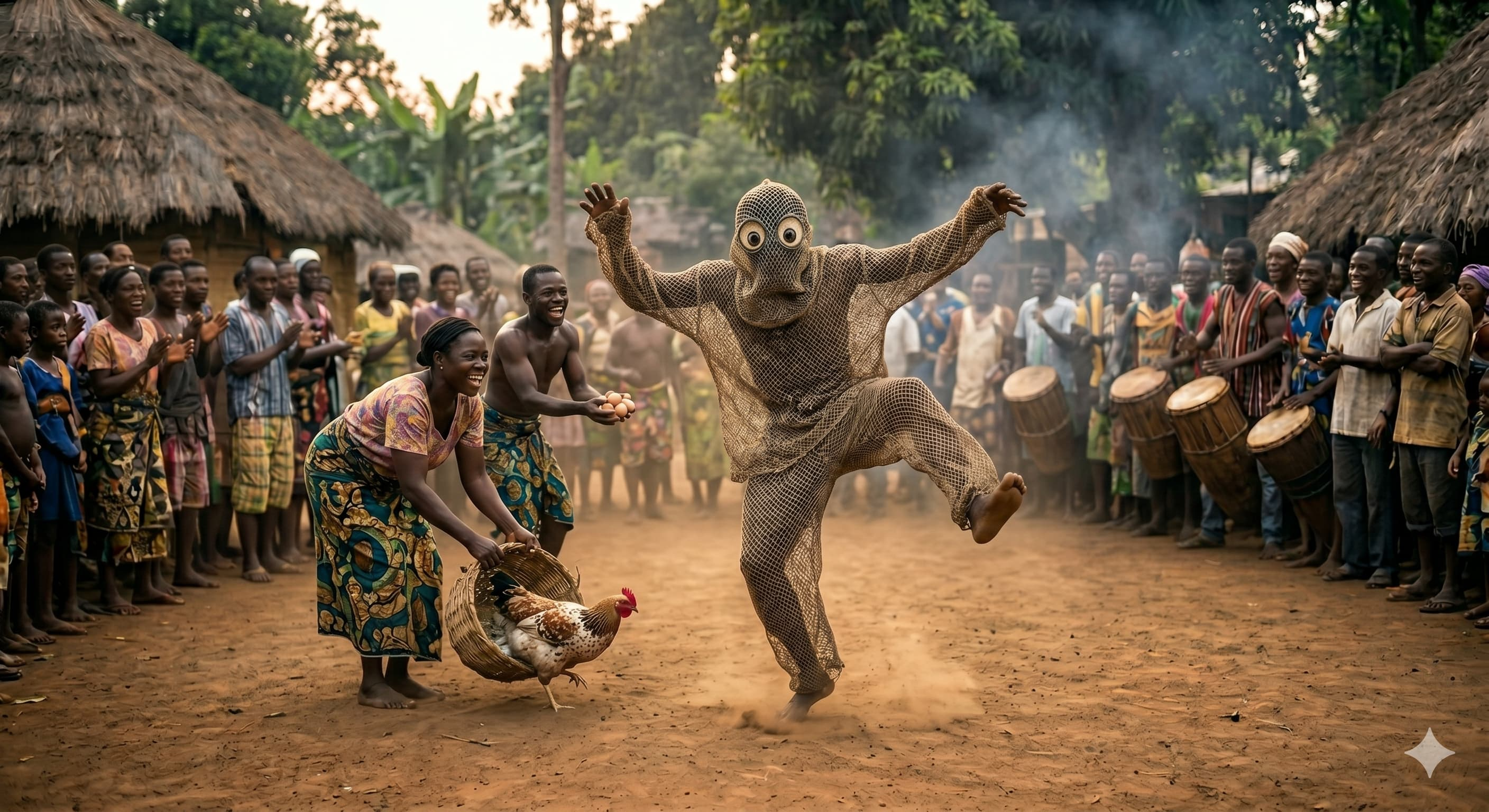
Moseke - The Clown
Suddenly, a strange character appears.
Covered in netting.
With large, round eyes.
Moving in playful, exaggerated steps.
This is Moseke.
He dances wildly.
He makes the crowd laugh.
If his performance is good, spectators reward him sometimes even with a live chicken.
Moseke reminds everyone that joy belongs even in sacred spaces.
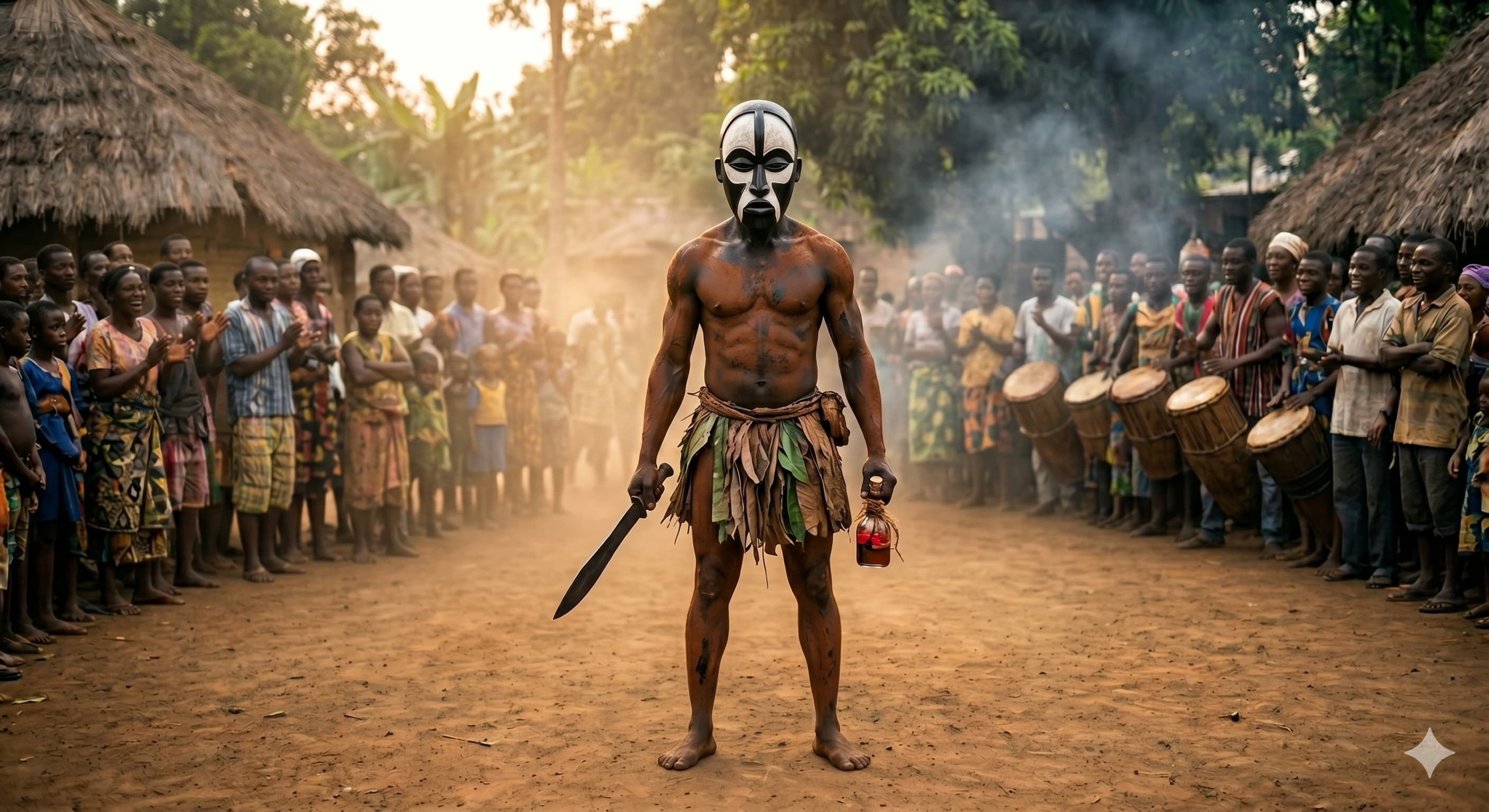
Ekpang’a Teta - The Enforcer
Then comes another figure.
Serious. Silent. Commanding.
Wearing a black-and-white wooden mask.
Carrying a knife and holding a charm bottle.
This is Ekpang’a Teta.
He enforces order.
He warns spectators to keep distance.
He reminds everyone this is not just entertainment.
This is sacred.
Then the Forest Returns to Silence
As evening approaches, the elephants take their final steps.
The dancers slowly withdraw and the masks are removed.
The Malle members gather privately for secret rituals hidden from outsiders.
But for the villagers, the experience remains unforgettable.
Because they have seen something rare.
Men becoming elephants.
The forest walking among people.
Tradition alive in the modern world.
Even today, the Veambe ceremony continues.
And if you ever find yourself near Mount Cameroon…
Listen carefully.
If you hear drums or shells rattling…
The forest may be walking again.
New Language Resources

Learn more about what happened Today in African history…
Join the Lughayangu Community!