What if I told you that over two thousand years ago, an African community figured out how to smelt iron into high-grade steel?
Before we get into that, let’s zoom out a little.
In economics class, we’re taught that industrialization is the engine of progress. Countries that manufacture their own goods tend to grow faster, trade better, and build stronger economies.
But for many African countries, the story goes differently.
We export raw materials -iron ore, coffee beans, cotton, etc. and then import back finished goods at ten times the price. It’s a lopsided system. One where we create the value, but someone else cashes in.
That’s what economists call an unfavourable balance of trade.
It’s one of the reasons we’re often seen as being “behind” in development.
📘 Explainer: What's Balance of Trade?
It's the difference between what a country exports (sells) and imports (buys).
- Export more than you import?
✅ That's a trade surplus. - Import more than you export?
❌ That's a trade deficit.
Example:
You grow maize.
- You sell 80 bags and import only 40 → surplus.
- You sell 30 bags and import 70 worth of ugali flour → deficit.
But this wasn't always Africa's story.
In fact, over 2,000 years ago, long before trade imbalances and shipping containers, one African community had already figured it out.
Not just how to mine iron, but how to master it.
Kagera, Western Tanzania. Around 100 BC.
The lake we now call Victoria was known by different names then: Ukerewe in Tanzania, Nalubaale in Uganda, and Nam Lolwe in Kenya.
In a quiet clearing near the lake’s western shores, a cone-shaped furnace roars with fire. A group of blacksmiths, farmers, and warriors gather around, working in rhythm.
They aren’t just making metal.
They’re forging something extraordinary.
The Furnace Process
To outsiders, it might look like fire and dirt.
But this was a deeply refined process.
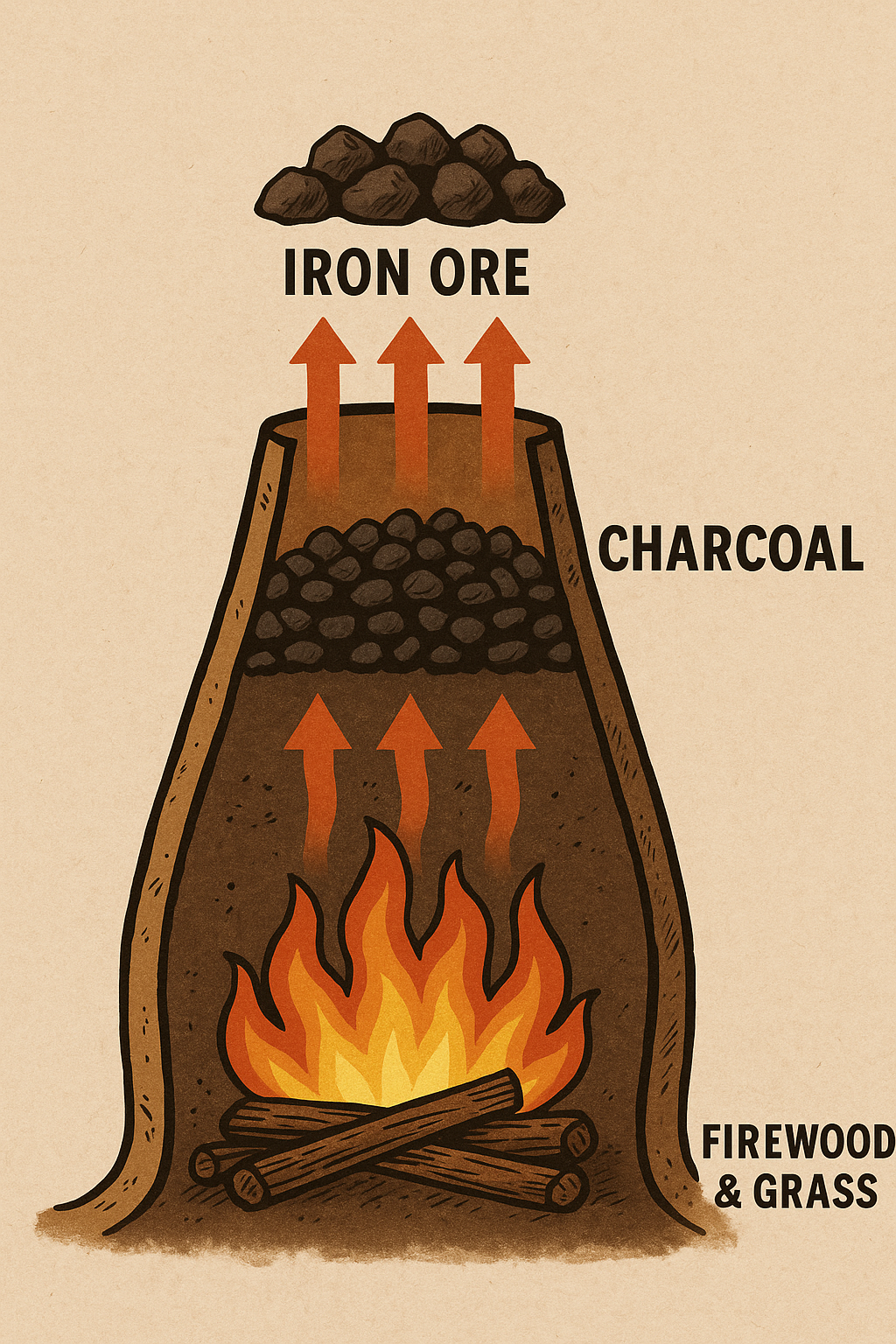
They started by burning grass and mud into charcoal, producing carbon.
Once the furnace reached scorching heat, up to 1,500°C, they added crushed iron ore.
That extreme heat fused the iron with carbon. The result?
Carbon steel, metal that is harder, stronger, and longer-lasting than plain iron.
They weren’t improvising.
They were engineering.
The Power of Steel
With stronger tools (the jembes, pangas, and machetes), they could farm more land and grow more food.
With sharper weapons (spears, knives, arrows), they could defend their homes and protect their territory.
Their steel tools became sought after across the region.
Trade flourished. Their economy grew.
Steel gave them food, power, and peace.
It wasn’t just strength. It was survival.
Europe Shows Up, Late
In 1877, German metallurgist Carl Siemens introduced the open-hearth furnace to Europe.
But by that time, the Haya had already mastered the same principle, using preheated air and natural draft to reach the temperatures needed for steel.
Africa wasn’t late to the party.
Sometimes, we were the party.
The Fade-Out
Like many African traditions, this knowledge faded when cheaper, mass-produced tools from Europe flooded the region.
About 50 years ago, the Haya stopped producing their own steel.
The furnaces went silent.
But not erased.
At least 13 of those ancient furnaces still stand today, quiet, cracked, and full of memory.
What If We Looked Back to Move Forward?
The next time we talk about progress, maybe we should start with a better question:
What did we already build?
And maybe, just maybe, the future starts with memory.
The Forge Lives On
The Haya lit the fire.
But they weren’t the end of the story.
Across the continent, African-owned industries are forging ahead, designing, building, producing, and proving that industrialisation isn’t a foreign dream.
Here are a few standouts:
🔩 Dangote Group – Nigeria
Cement. Sugar. Refined oil.
One of Africa’s boldest industrial empires, answering dependency with self-sufficiency, making the continent less dependent on imports.
🌾 OCP Group – Morocco
They don’t just mine phosphate. They feed the world.
Controlling 70% of global reserves, powering farms from Dakar to Dar es Salaam.
🚗 Innoson Motors – Nigeria
No more imported scraps.
The 1st made-in-Africa automobile brand, building vehicles by African hands, for African roads.
🏭 MeTL Group – Tanzania
From a local trader to a billion-dollar industrial force.
Textiles, cooking oil, drinks, soap - over 30 factories and counting.
🏗 Cevital – Algeria
Started with sugar. Now, glass, electronics, and global acquisitions.
Proof that African industry can scale and compete.
We've done it before. We're doing it now. The only question left is, what are we building next?
Enjoyed this story? Share it with someone who believes Africa can build its own future, one idea at a time. They can subscribe here.
Need help translating an African language? We’re building tools for that. Get help here.
Till next time,
Mike
Because our stories are worth telling.
Join the Lughayangu Community!